
Real or AI Quiz: Spot AI vs Real Photos
This AI or real photo quiz gives you 2–4 images per round, with only one authentic photo. Can you spot it? The newest models in the quiz, GPT Image 2, Nano Banana 2 and Seedream 5.0, generate near-photorealistic images. Older generators still leave telltale signs; the newest often leave none you can see. Play across seven categories with no signup and find out where your eye still works.
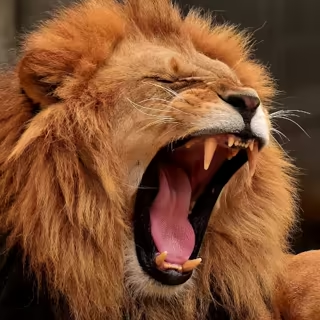
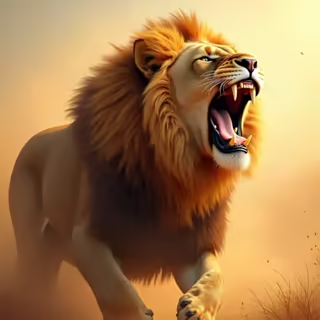
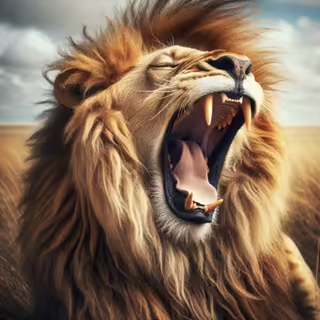
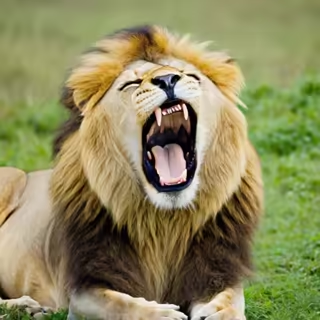
Try Two Rounds Right Here
Two example rounds from the quiz. Tap the photo you think is real, then see what gave the AI images away.
A woman with a classic car. Only one of these is a real photo. Which?


Real photo: Pexels . AI images labelled with the generating model after the reveal.
One of these red pandas is a real photo. Which one?
Real photo: Pexels . AI images labelled with the generating model after the reveal.
How Does the AI or Real Photo Quiz Work?
Each round presents 2–4 images — but only one is real. The others were created by AI models, from the newest (GPT Image 2, MAI-Image-2.5, Nano Banana 2, FLUX.2) back to older ones like DALL·E 3. Your task: find the authentic photo.
After each guess, we reveal which image was real and what gave the AI away, where anything did. You learn the tells that still catch older models, and you see how often the newest ones get past you. Choose from 7 categories: animals, nature, buildings, paintings, food, people, and cars — or play mixed mode, which draws from all of them.
Whether you searched for an AI vs real image quiz, an is it real or AI quiz or a quick AI image test, the rules are the same: look closely, pick one, and learn from the reveal. The image set changes every day at 00:00 UTC.
Choose Your Category and Start the Quiz
Pick a category below to jump right in — no signup needed
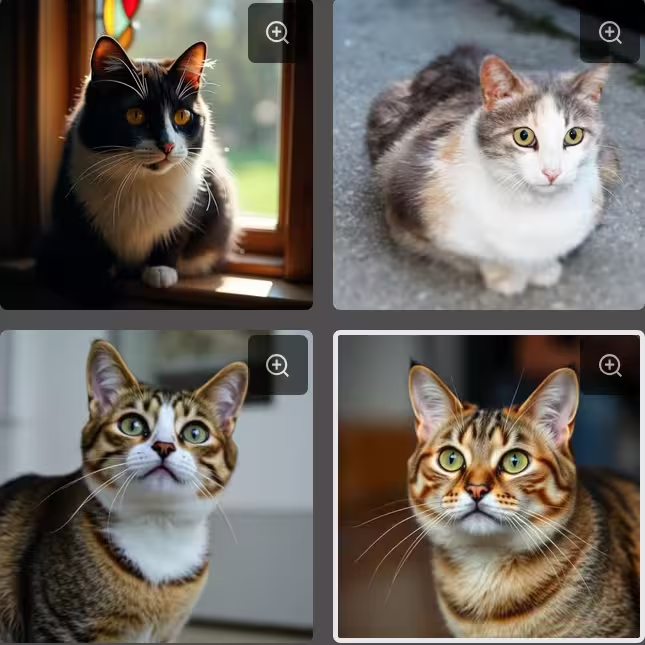
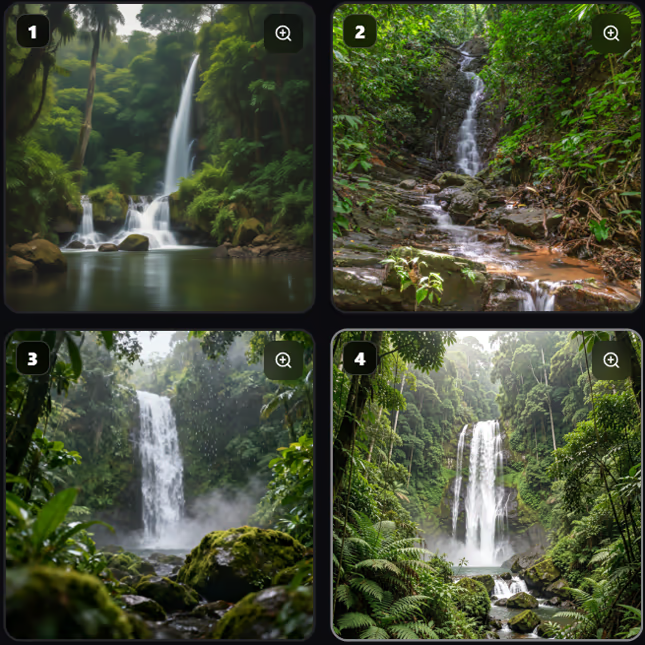
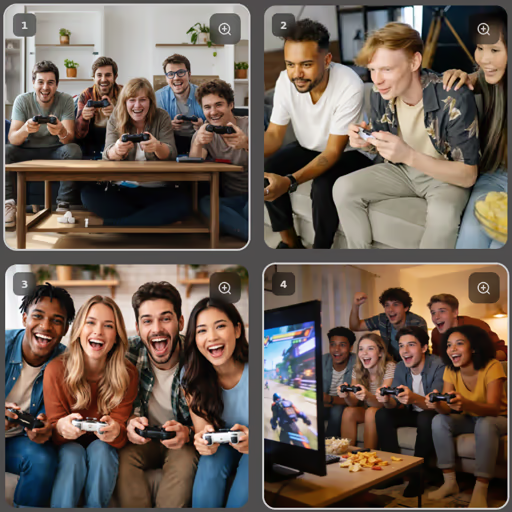
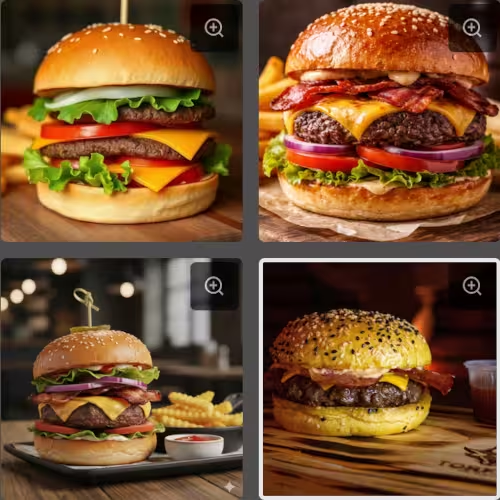
More Quiz Modes
Why It Matters: Real or AI in 2026
AI-generated images now appear in news articles, product listings, social media profiles, and political campaigns. Models like GPT Image 2, Nano Banana 2 and Seedream 5.0 can generate a photorealistic image in seconds at near-zero cost.
Practice helps against older generators, which still slip on text, anatomy and lighting. Against the newest models a close look is often not enough. In our model ratings, several of the newest (Nano Banana 2, Ideogram 4.0, Grok Imagine, GPT Image 2) are among the models that fool players most, while older fast models such as FLUX.1 [schnell] and SDXL-Lightning are among the easiest to catch.
So this real or AI quiz does two things. It trains you on the tells that still work, and it shows you where your eye stops being enough. From there, the useful skill is no longer spotting the fake but handling an image you cannot judge: checking where it came from before you share it or act on it.
When Your Eyes Are Not Enough
A Checking Order for Every Category
Most people scan an image as a whole and go with a gut feeling. That works until the fakes get good — and they now are. What holds up better is a fixed sequence, because AI fails in predictable places regardless of subject. It catches most fakes from older models and some from newer ones. An image that passes every step is still not proven real:
- Text first. Any writing in the frame — a sign, a badge, a label, a book spine. Older models turn it into invented letters, so if there is writing anywhere, this is the cheapest check available. The newest models often get short text right, so a clean sign proves nothing.
- Then repeated structures. Windows in a façade, tiles, railings, fence posts, teeth. Real repetition follows a rule; AI repetition drifts, skips or fuses elements together.
- Then contact points. Where two things touch: a foot on the ground, a hand around a cup, a wheel on tarmac. Generators render objects well but negotiate the boundary between them badly.
- Then the light. Pick two objects and check whether their shadows agree about where the sun is. Reflections in glass, metal or water should show a scene consistent with the rest of the frame.
- Only then the overall impression. If everything above passes and the image still feels too clean — no dust, no dirt, no awkward crop, no boring corner — that is itself a signal. Real photographs contain accidents.
Notice that “count the fingers” is not on this list. It used to be the standard advice and no longer works reliably — we wrote about the tells that stopped working separately.
The Reveal Is the Part That Teaches You
Guessing trains nothing on its own. What builds the skill is the few seconds after you answer, when both images are still on screen and you already know which was which. Most players skip straight to the next round and wonder why they plateau.
Two questions are worth asking every time, and they matter most when you were right:
- Which specific detail decided it? If you cannot name one, you guessed — and a guess that happened to land teaches you nothing you can reuse.
- Would that detail have worked on a different subject? A tell that only applies to this one image is trivia. A tell that generalises is a skill.
When you were wrong, resist the urge to move on quickly. Find the flaw you missed and name it out loud. Being able to articulate a tell is what makes it available to you next time — recognising something vaguely is not the same as being able to look for it.
Which Category Should You Expect to Struggle With?
Not the ones most people assume. Across 3,560 quiz decisions recorded between 25 June and 22 July 2026, the categories that sound easiest to verify — buildings and cars, with their hard, checkable geometry — were the two where players did worst. Each category page now carries its own live accuracy figure alongside the baseline that category is measured against, so you can check how the picture has moved since.
The numbers per category, why familiarity appears to work against you, and what the data cannot prove are all in the full analysis. If you would rather just pick a starting point, the quiz mode overview lists every category with its measured difficulty.
Frequently Asked Questions
Which category is the best to start with?
Animals is the most popular starting category — the differences are visible but not too subtle. Food is deceptively hard because AI-generated food looks hyperrealistic. People and portraits are the most challenging: modern AI can generate convincing faces that fool most players.
What AI models generate the fake images?
The newest fakes come from GPT Image 2 (OpenAI), MAI-Image-2.5 (Microsoft), Nano Banana 2 (Google), Seedream 5.0 Pro (ByteDance), FLUX.2 (Black Forest Labs), Qwen Image 2.0 Pro (Alibaba), Grok Imagine (xAI), Ideogram 4.0 and Reve 2.1. Older rounds from models such as DALL·E 3, Stable Diffusion and FLUX.1 stay in the pool, so you can see how far image generators have come. Each reveal names the model that made the fake; the AI image models overview has the details.
Can you tell the difference between real and AI images?
Sometimes, but not reliably. The quiz shows you how often current AI images fool you and which checkable flaws still turn up — useful calibration, not proof that practice turns anyone into a reliable detector. The reveals after each round explain what gave an image away, and the AI detection guide goes deeper. Before you share or act on an image, verify where it came from: the free AI awareness training shows how.