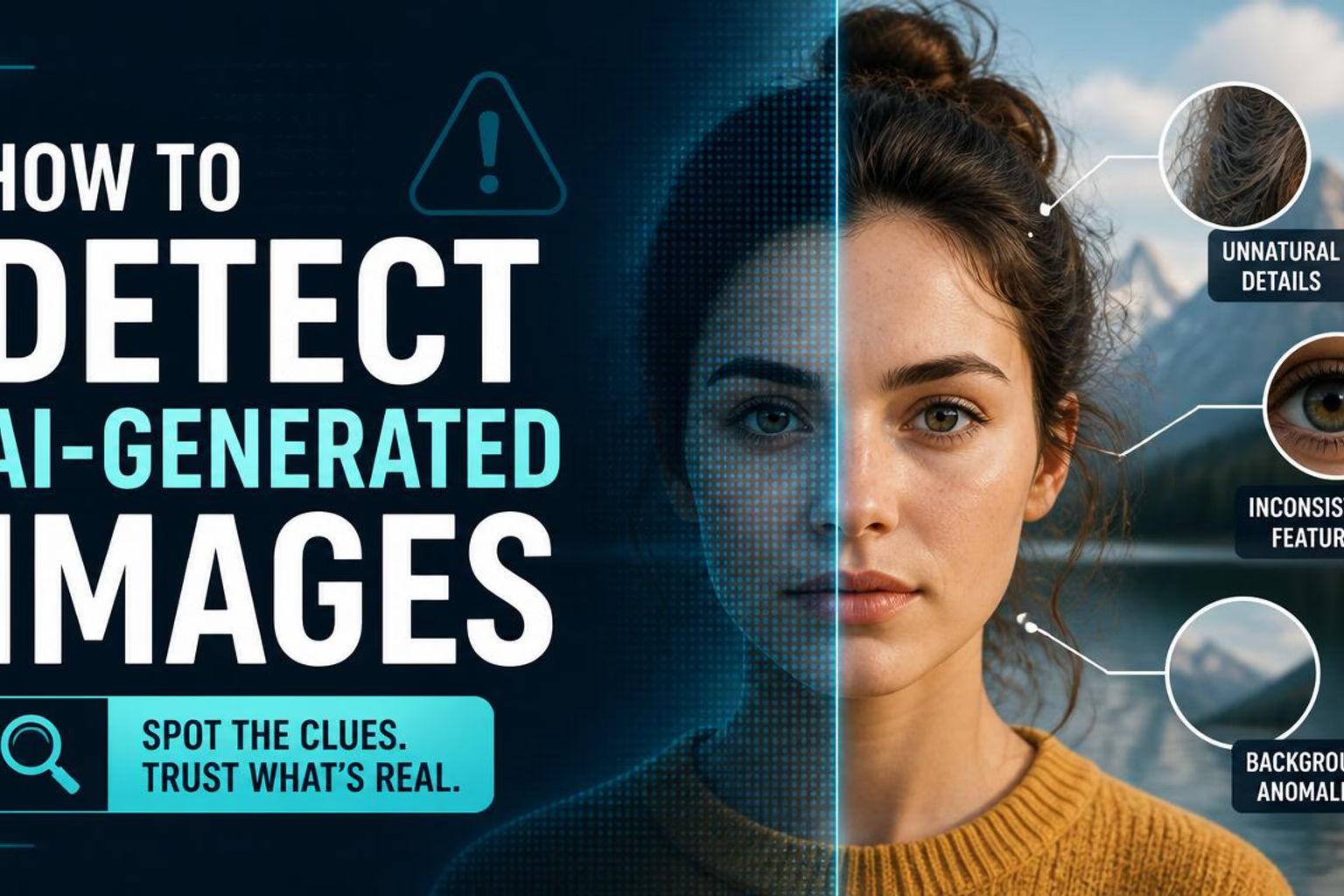
For a couple of years, spotting an AI-generated image was almost a party trick. Count the fingers. Look for the melted background. Find the nonsense text on a sign. If you knew the checklist, you could catch most fakes in seconds.
That era is over. The checklist still floats around social media as settled wisdom, but a large part of it stopped working somewhere around 2025 — because the models fixed exactly the things everyone had learned to look for. If you’re still relying on the old tells, you’re not just missing fakes; you’re being falsely reassured by images that pass a test the machines have already learned to beat.
Here’s an honest accounting of what died, what’s dying, and what still holds up.
Dead: counting fingers
The six-fingered hand was the single most famous AI tell, and it’s the most thoroughly solved. Early diffusion models genuinely couldn’t keep track of how many fingers a hand should have, because hands are small, high-variation, and appear in countless configurations. Modern models trained with far more data and better architecture handle hands correctly in the overwhelming majority of outputs.
You’ll still occasionally catch a bad hand — usually in a complex pose, or when hands interact with an object. But betting on finger-counting today means losing far more often than you win. If a hand looks fine, that tells you almost nothing.

Dead: garbled text
The other classic. For a long time, any text in an AI image — a shop sign, a book cover, a logo — came out as a smear of invented pseudo-letters. Newer models, especially those tuned for design and marketing use, render short pieces of text cleanly. A crisp sign is no longer proof of a real photo.
The nuance: long or dense text still trips models up. A paragraph of body text, a detailed menu, a page of a newspaper — these frequently still dissolve on close inspection. So text isn’t a dead tell so much as a narrowed one. Short text: unreliable. Dense text: still worth checking.
Dying: the melted background
The dreamy, smeared background — where a crowd becomes a blur of half-people and the architecture stops making sense — used to be a giveaway. Models have improved sharply here too. Backgrounds are more coherent, crowds are more convincing, and depth of field is simulated well enough to hide a lot of sins.
It’s not fully dead. Push into the deep background of a busy scene and you can still find cloned figures, a doorway that leads nowhere, or railings that change direction. But you have to look harder than you used to, and a “clean enough” background is no longer a green light.
Still working: physics and consequence
Here’s the shift that matters. The tells that survived aren’t about individual objects — they’re about relationships between things. Models render objects beautifully but still struggle to keep a whole scene internally consistent.
- Light and shadow. Does every shadow fall in a direction consistent with a single light source? AI often lights each element convincingly on its own, then forgets they share a room.
- Reflections. A mirror, a window, sunglasses, a puddle, a car door — reflections must match the scene, and this is genuinely hard for a model to get right. Reflections remain one of the most reliable tells.
- Scale and contact. Where two things meet — a hand gripping a mug, a shoe pressing on grass, a person sitting on a chair — the point of contact is where fakes fall apart. Objects float, merge, or don’t quite touch.
- Symmetry that should be there but isn’t (and vice-versa). Pairs of earrings, shoes, wheels, eyes: AI frequently makes the two members of a pair subtly different in a way reality wouldn’t.

None of these are about spotting an ugly artifact. They’re about asking whether the scene could physically exist. That’s a harder habit to build, but it’s the one that still pays off — and it’s the core of our full guide to detecting AI images.
Still working: “too perfect”
The other survivor is aesthetic, not technical. AI images tend toward an average of their training data, which means they drift toward the flawless: skin without real pores, food without a single crumb out of place, a street with no litter and no awkward parked car. Reality is messier. When an image looks like it was optimised to be pleasing rather than captured in a moment, that instinct is worth trusting — it’s especially strong in categories like food, where AI overshoots into the hyperreal.
Why the checklist keeps going stale
The deeper lesson is that any specific, nameable tell has a shelf life. The moment a giveaway becomes common knowledge, it also becomes a benchmark the next generation of models is trained and evaluated against. Popular tells are, in effect, a to-do list for the people building these systems. Finger-counting worked until it was famous enough to fix.
That’s why the durable skill isn’t memorising a list — it’s calibration. You get better by seeing many real and fake examples side by side, being told which was which, and letting your intuition absorb the current gap between them. It’s also why a static article can only take you so far, and why practice beats theory.
What to actually do
- Stop trusting the dead tells. A good hand and a clean sign prove nothing now.
- Shift your attention from objects to relationships — light, reflections, contact points, pairs.
- Trust the “too perfect” instinct, especially on faces and food.
- Assume your mental checklist is a year out of date, and refresh it by testing yourself against current models — not the ones from two years ago.
The uncomfortable truth is that pure visual detection gets harder every year, and at some point provenance will matter more than anything you can see with your eye. That work is already underway: the C2PA standard defines tamper-evident “content credentials” that travel with a file to record how it was made, the Content Authenticity Initiative is pushing adoption across camera makers and editing software, and Google’s SynthID embeds imperceptible watermarks directly into AI-generated output.
None of that is universal yet. Durable Content Credentials may survive metadata stripping through watermarks or perceptual fingerprints, while plain metadata alone may not. So in the meantime, a trained eye still beats an untrained one by a wide margin — and it’s worth understanding where fake images actually cause harm, because that’s where the skill pays off.
Want to find out where your eye actually stands against 2026-era models? Take the Real or AI quiz and watch the reveals — that feedback loop is the fastest way to recalibrate.