
AI Food Quiz: Real Dish or AI Fake?
DALL·E 3, Stable Diffusion, or a real photo? AI can generate mouth-watering food images. Can you spot which dish is actually real?
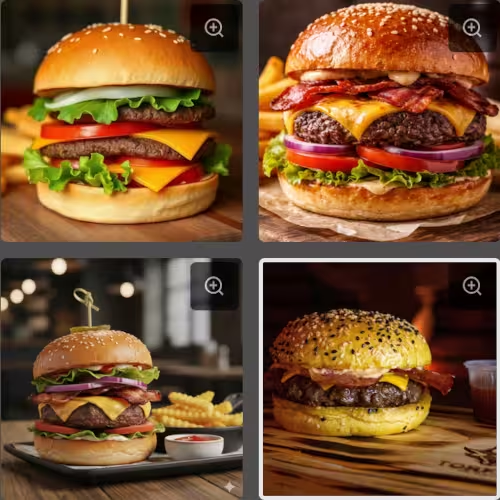
The Food Paradox: When "Too Perfect" Is the Tell
Food is one of the trickiest categories on the site — but not for the reason you'd expect. Image models have been trained on an ocean of professional, styled food photography, so they're extremely good at producing dishes that look appetising. The problem for the AI is that it tends to overshoot: the result is often more perfect than any real plate — flawless symmetry, every seed placed just so, a permanent studio glisten.
Real food photography, even the professional kind, carries tiny accidents a camera actually recorded: a crumb out of place, an uneven char, a smear on the plate rim, a highlight that falls where the light happened to hit. Learning to trust those imperfections — rather than the polish — is the single biggest jump in your food-detection accuracy.
Worked Example: A Margherita Pizza
Say a round shows you four near-identical Margherita pizzas. Here's the order I'd check them in:
- The basil leaves. Real basil is irregular — different sizes, a torn edge, one leaf curling. AI often clones a single "perfect" leaf several times, or gives basil an unnaturally waxy sheen.
- The char on the crust. A real wood-fired crust has random, uneven leopard-spotting. AI char tends to be evenly distributed, almost decorative, like it was airbrushed on.
- The cheese pull and pooling. Melted mozzarella has browned bubbles and thin translucent edges. AI cheese frequently looks like a solid, matte blanket with no browning logic.
- The plate and background. The fastest tell of all: check the plate rim and the table behind. AI still smears cutlery, warps a fork, or blurs the background into an impossible surface.
Get through those four checks and you'll beat most players — even before the reveal explains what the AI got wrong.
Five Tells That Are Specific to Food
- Steam & heat — genuinely hot food gives off faint, wispy steam that rises and diffuses. AI steam is often absent, or painted on as a solid white cloud that ignores airflow.
- Liquids & sauce — soup, broth and glaze reflect their surroundings and pool according to gravity. AI struggles with the physics of a poured sauce and the reflections on a wet surface.
- Cut cross-sections — the inside of a cake, a slice of bread, a cut steak. Real crumb and muscle fibre have structure; AI tends to smear the interior into a uniform paste.
- Repeated small units — sesame seeds, peas, sprinkles, caviar. Look for suspiciously identical, cloned units — a classic AI shortcut.
- Cutlery & hands — forks, chopsticks and fingers holding a burger are where AI most reliably falls apart: bent tines, merged chopsticks, an extra knuckle.
How the Models Handle Food Differently
Because you can switch on "Show model names", food is a great category for learning each generator's habits:
- DALL·E 3 — strong composition and plating, but textures can turn plasticky and garnishes often look placed rather than fallen.
- Stable Diffusion — the widest range: some outputs are startlingly photoreal, others betray cloned units and mushy cross-sections.
- Gemini 2.5 Flash Image (Nano Banana) — excellent lighting and colour, occasionally too glossy, and it can miss fine details like crumb structure.
- GPT Image 1.5 — clean and polished, which can create the same “too perfect” trap as professional food styling.
Dishes in rotation include pizza, sushi, ramen, hamburgers, paella, rendang, pancakes and more.
How Players Actually Do Here
Across 11,532 rounds on 20photographs, players picked the real photo69% of the time. Because rounds in this category do not all show the same number of options, the baseline is 25% rather than a flat coin flip — which puts real performance at 2.75× chance, the category people read best.
From answers given on this site, recomputed nightly · last updated 14 October 2026. Within a visit only a player's first answer to a round counts; a replay in a new visit is not recognised, which nudges this figure slightly up. How this is measured · Per-model ratings
Frequently Asked Questions
Why is AI-generated food so hard to spot? ▾
Image models were trained on millions of professional food photos, so they produce hyperreal, studio-lit dishes. The paradox: AI food often looks too perfect — flawless symmetry, glistening surfaces and ideal garnish. Real food photography usually has small imperfections a camera captured, which is often the giveaway.
What are the biggest tells of a fake food photo? ▾
Steam that doesn't rise naturally, sauce and liquid with impossible reflections, cut cross-sections (cake crumb, bread, meat fibres) that smear instead of showing structure, cutlery that bends or merges, and repeated units like identical sesame seeds or peas that betray AI cloning.
Which AI models generate the fake food images? ▾
Fakes are produced with verified models including DALL·E 3, Stable Diffusion, Gemini 2.5 Flash Image (Nano Banana) and GPT Image 1.5, each paired against a real photograph. Turn on "Show model names" before you start to see which model made each image after every round.
More Quiz Categories

Want the full method? Read our guide to detecting AI-generated images.