
AI Art Test: Real Painting or AI-Generated?
Can you tell a real Van Gogh from an AI-generated copy? Modern AI can replicate artistic styles with stunning accuracy. Put your art knowledge to the test.
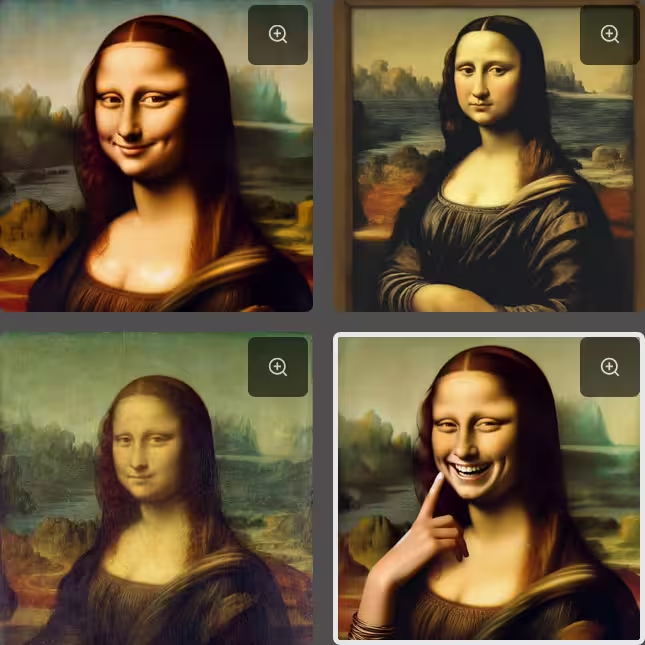
This is a playable 10-round AI art test using famous paintings and synthetic imitations. For research results from a separate 11,000-person experiment, read our AI Art Turing Test analysis.
Why This AI Art Test Is a Different Game
Every other category asks you to find a real photograph. Here, the authentic image is a famous painting — so the usual photographic tells (garbled text, warped hands, broken reflections) don't apply. That makes this an AI art vs real art test rather than photo forensics: telling AI or human art apart rewards knowing the actual artwork, not spotting rendering errors.
AI has learned the style of Van Gogh or Klimt from thousands of examples, but it has not learned the specific painting. So it reproduces the mood convincingly while quietly getting the facts wrong: a cypress tree that shouldn't be there, a village that's the wrong shape, a star count that doesn't match. If you know the original, the fake practically announces itself.
Worked Example: Van Gogh's "The Starry Night"
Four swirling blue night skies, one genuine. Here's what actually separates them:
- The cypress tree. In the real painting a large dark cypress rises up the left edge like a flame. AI versions often shrink it, move it, or drop it entirely.
- The village and church spire. The original has a specific little town with a tall, thin church steeple. Fakes tend to invent a generic village or misplace the spire.
- Brushstroke logic. Van Gogh's swirls follow a deliberate directional rhythm — the impasto has real physical direction. AI swirls imitate the look but flow randomly, with no consistent stroke path.
- Surface age. Look for craquelure — the fine web of cracks in old varnish. A faithful photo of the real canvas shows it; AI either omits it or lays down an unnaturally even, fake crack pattern.
These are art-history checks, not photo forensics — which is exactly why this category trains a different skill.
Masterpieces in Rotation
The quiz draws on instantly recognisable works, so you're testing recognition as much as observation:
- Leonardo da Vinci — Mona Lisa
- Vincent van Gogh — The Starry Night, Café Terrace at Night, Irises
- Edvard Munch — The Scream
- Gustav Klimt — The Kiss
- Claude Monet — Impression, Sunrise
- Caspar David Friedrich — Wanderer above the Sea of Fog
Tells That Are Specific to Paintings
- Composition drift — elements moved, added or missing compared with the original you remember.
- Directionless brushwork — the style is imitated but the strokes don't follow the artist's real logic.
- Signature & lettering — an invented signature, or a title card AI couldn't spell.
- Fake or missing craquelure — either no age cracks at all, or a too-even mesh that no real varnish forms.
- Frame & canvas edges — AI often can't decide whether it's painting the artwork or a photo of a framed artwork, and the edges give it away.
The AI versions are generated with DALL-E 3, Stable Diffusion and Google Imagen.
How Players Actually Do Here
Across 12,533 rounds on 24photographs, players picked the real photo64% of the time. Because rounds in this category do not all show the same number of options, the baseline is 25% rather than a flat coin flip — which puts real performance at 2.55× chance, the category people read best.
From answers given on this site, recomputed nightly · last updated 14 October 2026. Within a visit only a player's first answer to a round counts; a replay in a new visit is not recognised, which nudges this figure slightly up. How this is measured · Per-model ratings
Frequently Asked Questions
How is the art quiz different from the photo quizzes? ▾
The "real" image here is a well-known painting, not a photograph, so the tells are different. Instead of photographic artefacts you check iconography and composition: AI reproductions of famous works subtly rearrange elements, drop a detail, or get the brushstroke direction wrong. Knowing the original is your biggest advantage.
What gives away an AI-generated painting? ▾
Composition drift (elements moved, added or missing versus the original), directionless brushwork that imitates a style without the artist's real stroke logic, invented or missing signatures, and craquelure that is either absent or applied as an even, fake mesh.
Isn't a photo of a painting also not the "real" thing? ▾
Fair point — the authentic image is a photograph or museum scan of the genuine artwork, versus an AI-generated imitation of that same painting. The quiz is about telling the faithful reproduction from the synthetic fake, not physical originals versus prints.
Which artists and works are featured? ▾
Works include da Vinci's Mona Lisa, Van Gogh's Starry Night and Irises, Munch's The Scream, Klimt's The Kiss, Monet's Impression Sunrise and Friedrich's Wanderer above the Sea of Fog, among others.
More Quiz Categories
Want the full method? Read our guide to detecting AI-generated images.