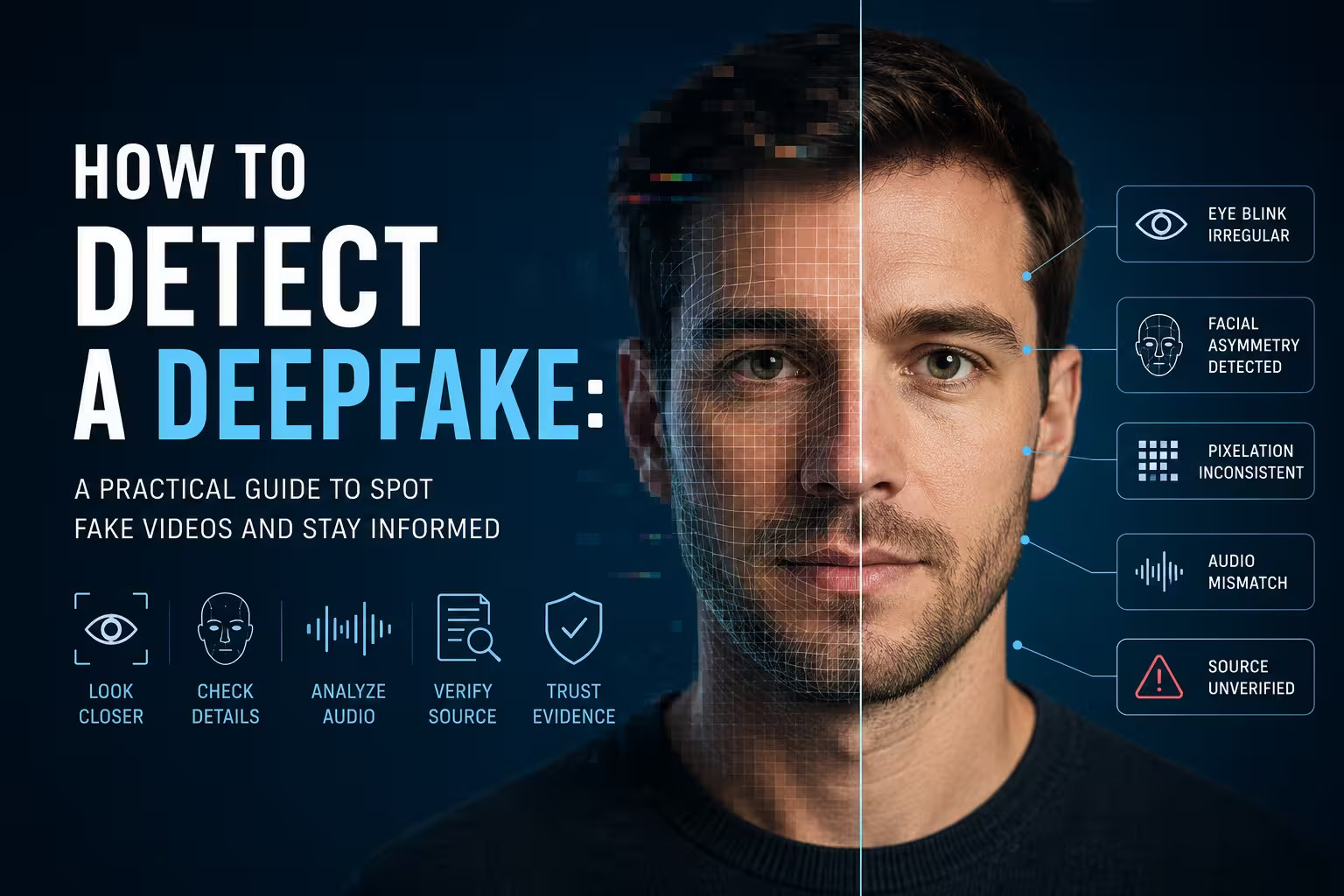
The best AI video detector for most people in 2026 is Hive, because it covers both fully generated video and deepfake manipulation, returns a confidence score, and is easier to try than most enterprise products. Reality Defender is the stronger fit for organizations building a serious verification workflow. Deepware Scanner is the simplest free option for checking a suspicious face-swap clip, while Sightengine makes more sense for developers who need an API.
That is the short answer. The important caveat is that none of them can tell you with certainty whether a video is real. In a practical comparison, the useful question is not “Which detector never gets it wrong?” There is no such tool. It is: which detector gives the most useful signal for the kind of video you actually need to check?
Our picks at a glance
- Best AI video detector overall: Hive Detect. Broad coverage, useful confidence scores, and support for images, video, and audio.
- Best for enterprise investigations: Reality Defender. An ensemble approach and tools designed for media, fraud, and security teams.
- Best free deepfake video detector: Deepware Scanner. Fast and approachable for face-centric clips, but much narrower than a general synthetic-video detector.
- Best public checker and video detection API: Sightengine. Supports direct browser checks as well as automated moderation and high-volume screening.
- Best for broadcast and live streams: NVIDIA Synthetic Video Detector. A GPU microservice with a free browser trial, built for frame-level checks fast enough for live production.
If you only have one questionable clip, start with Hive or Deepware, then verify the result with a second method. If the video could affect a payment, a person’s reputation, a news report, or legal action, do not make the decision from a detector score alone.
Quick comparison
 Sightengine ↗
 Hive Detect ↗
 Reality Defender ↗


 NVIDIA SVD ↗
The short version: if you want the cleanest public-facing option, start with Sightengine. If you need a broader signal and do not mind a more enterprise-minded workflow, Hive is the stronger all-round choice.
If you want to practice on labeled examples too, compare your instinct with the tools above.
How the AI video detectors were compared
This is a feature and documentation comparison, not a hands-on test or peer-reviewed benchmark. The tools are assessed by the workflow they offer a reader, newsroom, or moderation team: upload a suspicious file, inspect the result, and decide whether the output helps with the next step.
The comparison considers four common kinds of material:
- Ordinary camera footage, including compressed and low-light clips
- Face-swap and lip-sync deepfakes
- Fully synthetic text-to-video clips from current-generation models
- Re-encoded versions that had been downloaded, cropped, captioned, or passed through social media
That last group matters. A pristine generator output is the easiest possible detection case and not how most questionable videos reach you. Social platforms resize and recompress uploads. People add subtitles, logos, music, and cuts. Those changes can weaken the statistical traces a detector relies on.
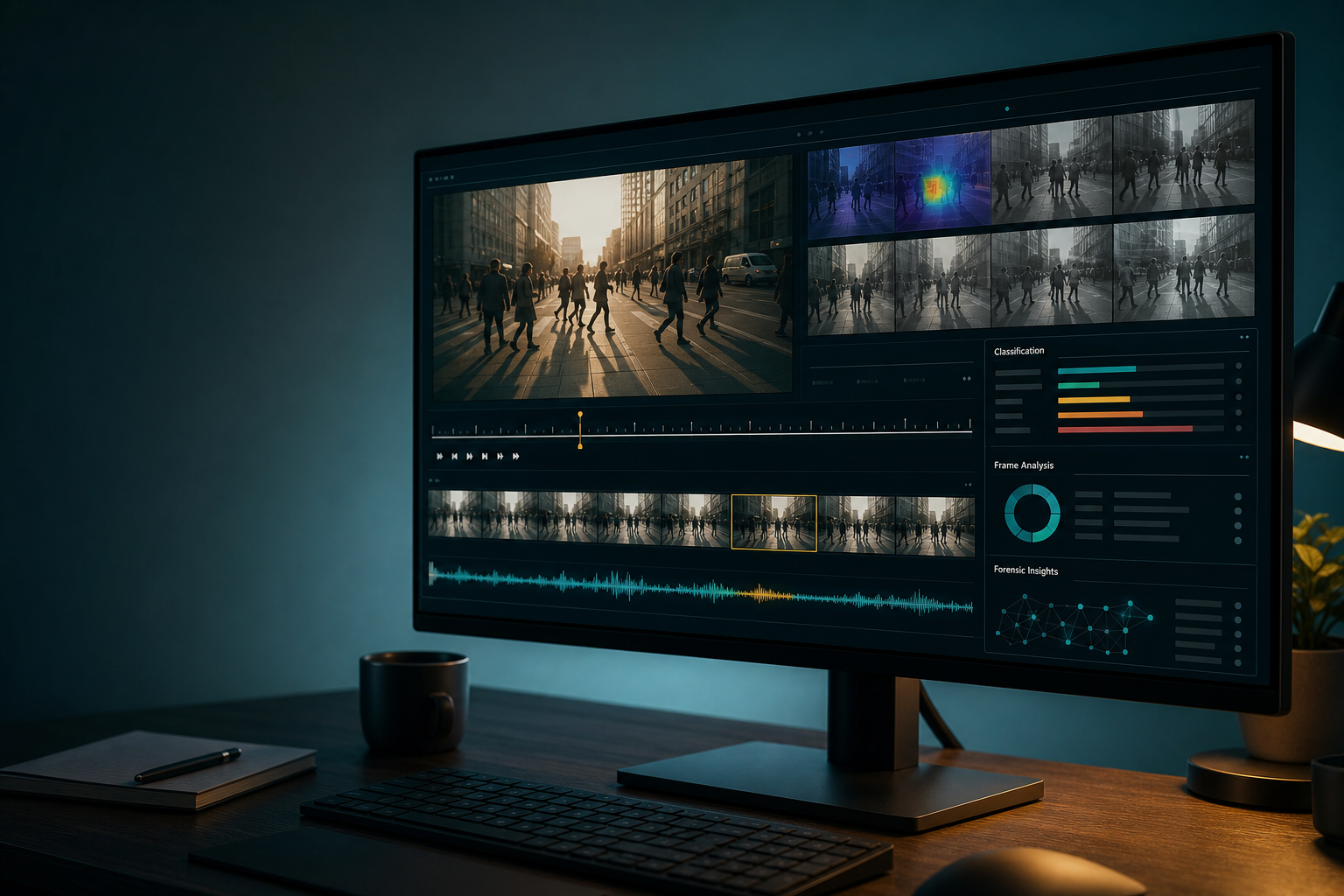
Each service is assessed against five practical questions:
- Does it accept video directly, rather than asking for still frames?
- Does it cover fully generated clips as well as traditional face swaps?
- Is the output understandable without forensic training?
- Does it remain useful after ordinary compression and editing?
- Are its access, privacy, and pricing terms realistic for the intended user?
This guide does not attach a universal “92% accurate” number to any tool. A percentage from one test set can collapse when the generator, codec, subject, or editing process changes. Vendor accuracy claims are not directly comparable unless every service is evaluated on the same unseen files under the same conditions.
1. Hive: best AI video detector overall
Hive Detect’s AI-generated and deepfake detection is the most balanced option in this comparison. It is designed to scan video, images, and audio, and its result is a confidence score rather than a blunt red or green badge. Hive may also identify the likely generation engine when its classifier recognizes one.
The breadth is its main advantage. Many tools that call themselves deepfake detectors are really face-manipulation detectors: they look for a swapped face, altered mouth, or synthetic talking head. Hive also aims to catch wholly generated scenes, where every pixel comes from a model such as Veo, Kling, or Sora and there may be no real face to inspect.
What it offers:
- Covers AI-generated video and deepfake manipulation in one product
- Gives a graded result that can be combined with other evidence
- Regular model updates are part of the product’s stated approach
- Browser tools make quick checks more accessible than enterprise-only platforms
Limitations:
- A confidence score can look more conclusive than it is
- Short, heavily compressed, or edited clips provide less signal
- Full API use is aimed more at platforms and businesses than casual users
Verdict: Hive is the best first check for a mixed stream of suspicious media. It is not a truth machine, but it is the least narrow of the accessible options in this roundup.
2. Reality Defender: best for enterprise verification
Reality Defender is built for a different buyer. Its platform analyzes video, image, and audio with an ensemble of detection models rather than depending on one classifier. That approach is sensible: different models can look for different traces, and one detector’s blind spot does not automatically become the whole system’s blind spot.
The output and workflow are better suited to a fraud team, newsroom, marketplace, or security operation than to someone checking a single viral post. Reality Defender also offers API access and products aimed at live calls and video-conferencing risks, where detecting a synthetic participant quickly matters more than producing a simple consumer-facing score.
What it offers:
- Multi-model approach instead of a single detector
- Handles multiple media types within the same verification stack
- Better fit for repeatable review, escalation, and audit workflows
- Designed around high-risk impersonation and fraud cases
Limitations:
- More setup than a no-login web scanner
- Video access and useful volume may require a commercial relationship
- The result still needs a trained reviewer and corroborating evidence
Verdict: Reality Defender is our pick when detection must become an organizational process, not just a one-off check. For an individual with one clip, it is probably more platform than you need.
3. Deepware Scanner: best free deepfake detector
Deepware Scanner has the clearest consumer proposition: submit a suspicious video and scan it for synthetic manipulation. It is quick to understand and useful when the clip is centered on a person’s face.
That focus is also the limitation. “Deepfake” once mostly meant a face swap or manipulated talking head. In 2026, a fake video may instead be generated end to end: a flood, an animal encounter, a sports highlight, or a street interview with no original footage underneath. A face-focused scanner is not automatically trained to recognize all of those.
What it offers:
- Low-friction way to scan a face-centric video
- Clearer for non-technical users than an API response
- Useful as a free second opinion on suspected face manipulation
Limitations:
- Narrower coverage than a general AI-generated video classifier
- A “no deepfake detected” result does not prove the clip was camera-shot
- Results depend heavily on having a visible, sufficiently large face
Verdict: Deepware is the best free starting point for a traditional face swap. It is not our first choice for landscapes, animals, action scenes, or other fully synthetic footage. For those, use a broader detector and inspect the video itself.
4. Sightengine: best AI video detection API
Sightengine’s AI video detection fits developers who want to screen uploads automatically. It sits alongside the company’s broader image and video moderation products, so detection can become one signal in a larger pipeline that also checks unsafe content, text, and other policy categories.
Sightengine supports both direct browser uploads and an API. A product team can submit files through the API, define a review threshold, record the result, and send uncertain cases to a human, while someone checking one clip can use the public web checker.
What it offers:
- API-first workflow for apps, marketplaces, and moderation systems
- Can sit inside a broader video-review pipeline
- Better suited to repeat screening than a browser-only detector
Limitations:
- Public web checker is available, but free allowances can change
- Requires developers to choose thresholds and handle uncertain results responsibly
- Automated scale can multiply false positives if no human review step exists
Verdict: Sightengine is the practical developer choice. The quality of the final system will depend as much on your review policy as on the model response.
5. NVIDIA Synthetic Video Detector: best for broadcast and live streams
The NVIDIA Synthetic Video Detector is the newest entry here and the one with the most unusual shape. It is a NIM microservice — software a broadcaster or platform runs on its own GPUs — rather than a consumer website. NVIDIA also hosts a browser trial on build.nvidia.com, so a single clip can be checked without deploying anything, though the trial asks you to create an account.
Speed is the point. NVIDIA describes frame-level analysis of 1080p video in roughly 22 ms on RTX hardware, which is what makes checks inside a live feed plausible rather than theoretical. At IBC 2026 the company named Dalet, TwelveLabs and Wowza as partners putting it into news verification, compliance screening and livestream analysis.
The accuracy claims need reading carefully, and they are the reason this sits fifth rather than first. NVIDIA’s IBC announcement cites 99.3% for text-to-video and 97.7% for image-to-video content. NVIDIA’s own model documentation reports a different and more sobering picture once footage is compressed: around 92% on uncompressed video, about 87% at 15% compression and roughly 82% at 50%. Compressed, re-uploaded video is the normal case for anything that reaches you through social media.
What it offers:
- Frame-level results fast enough for live broadcast workflows
- Free browser trial for one-off checks, plus a self-hostable microservice
- Files can stay inside your own infrastructure when self-hosted, which matters for sensitive material
Limitations:
- Built for media organisations; the deployment path assumes GPUs and engineers
- The headline accuracy figures fall noticeably on compressed footage
- Focused on generated video, not a general check for false captions or context
Verdict: The strongest option when video has to be checked at broadcast speed or the footage must not leave your own servers. For a single suspicious clip from social media, the browser trial works, but Hive or Deepware involve less friction.
Why AI video detection is harder than AI image detection
An AI image detector examines one fixed arrangement of pixels. A video adds time, compression, motion blur, cuts, audio, subtitles, and potentially thousands of frames. That creates more evidence, but also more ways to hide or destroy it.
A video detector may sample only some frames. If a manipulated face appears for two seconds in a minute-long clip, the relevant frames can be diluted by ordinary footage. Conversely, a real low-light clip may flicker, smear, or warp under compression in ways that resemble generation artifacts.
There is also no single category called “AI video.” A detector may face:
- A real video with one swapped face
- A real video with an AI-generated mouth and cloned voice
- A generated subject composited into a real background
- A fully generated clip with synthetic visuals and audio
- A real clip falsely captioned to claim it shows something else
The last case is especially important: an AI detector cannot detect a false caption on a real video. Source verification remains necessary even when every pixel is authentic.
This is why results from an AI image detector do not automatically carry over to video, and why our separate deepfake guide focuses on face boundaries, lip sync, and temporal flicker rather than general text-to-video detection.
Can a free AI video detector be trusted?
A free detector can be useful for triage. It can tell you that a clip deserves closer inspection or that two independent systems see different signals. It cannot certify authenticity.
Before uploading anything, also ask what happens to the file. A private family video, internal company call, unreleased campaign, or identity document is not a good candidate for an unknown public scanner. Check the service’s privacy policy, retention terms, and whether submitted media may be used to improve its models. For sensitive material, an approved enterprise service or local forensic workflow is safer.
Treat a free result according to its direction:
- High AI probability: a reason to investigate, not permission to accuse someone
- Low AI probability: weak reassurance, not proof that the video is real
- Uncertain or mixed: often the most honest result, especially after compression
- Unsupported file or failed scan: no evidence either way
The asymmetry matters. A detector that recognizes a known generator trace may have found real evidence. Failure to find that trace only means the detector did not find it.
How to check a suspicious video properly
For a low-stakes curiosity, one detector may be enough. For anything consequential, use a layered process.
- Preserve the best available file. Download the original rather than screen-recording it. Keep the URL, timestamp, filename, and message context.
- Check the source before the pixels. Find the earliest upload, the account’s history, and independent footage of the same event. Reverse-search representative frames.
- Run two different detectors. Prefer tools with different approaches. Agreement is more useful than repeatedly submitting the same clip to clones of one service.
- Inspect the timeline. Slow the clip down and step through frames. Look for details that change identity, disappear, or fail to obey physical continuity. Our real-or-AI video guide is a useful way to practice this skill on labeled examples.
- Separate visual and audio claims. A real-looking video can carry a cloned voice, and authentic audio can be attached to generated visuals.
- Look for provenance. Content credentials, an original camera file, or a traceable publication history can be stronger evidence than a classifier score.
- Escalate high-stakes cases. Journalists, legal teams, banks, and employers should use trained forensic review before publishing an allegation or taking action.
Do not average detector percentages as if they were votes. An 80% score from one service and a 20% score from another do not make a video “50% AI.” The models may be measuring different things, using different calibration, or failing on different parts of the clip.
AI video detector FAQ
What is the best AI video detector in 2026?
Hive is the best overall choice for most users because it covers both fully AI-generated video and deepfake manipulation. Reality Defender is better suited to enterprise verification, Deepware is a useful free face-swap scanner, and Sightengine is the better fit for API-based moderation.
Is there a free AI video detector with no signup?
Deepware Scanner offers a straightforward way to scan suspicious videos, and Hive offers accessible demo and browser-based detection options. Free access, supported file sizes, and login requirements can change, so check the current terms before relying on a service for a recurring workflow.
Can an AI detector identify videos made with Sora, Veo, or Kling?
Some broad synthetic-media classifiers are trained on outputs from popular video generators and update as new models appear. Coverage always lags behind releases, however. A detector may recognize one version of a model and miss another, especially after the clip has been edited or recompressed.
Can AI video detectors be wrong?
Yes. They can flag real footage as synthetic and miss generated footage. Low light, beauty filters, stabilization, frame interpolation, heavy compression, animation, and visual effects can all complicate classification. Never use one score as the sole basis for a public accusation or high-impact decision.
Is a deepfake detector the same as an AI video detector?
Not always. A deepfake detector may specialize in manipulated faces or voices, while an AI video detector may look for fully generated footage. Check which media and manipulation types a tool actually supports rather than relying on the label.
The bottom line
Hive is the strongest all-round AI video detector in this roundup, Reality Defender is the better enterprise system, Deepware is the easiest free face-swap check, and Sightengine is the most practical API option. None can certify that a video is real.
Use detection software to decide what to investigate next. Then check the source, inspect the timeline, compare independent evidence, and preserve uncertainty when the evidence is mixed.