How to Detect a Deepfake: 8 Visual Tells That Reveal AI Face Swaps
Deepfakes have moved from clunky 2018 experiments to near-undetectable video forgeries. Politicians, celebrities, and ordinary people are being misrepresented. The average person scores only 55% on detection tests — barely better than guessing. This guide shows you exactly how to detect them.
The 8 visual tells below work across face-swap deepfakes, synthetic AI-generated faces (Flux, Midjourney, GPT Image), and audio-driven video fakes. With deliberate practice, accuracy improves from 55% to around 65%.
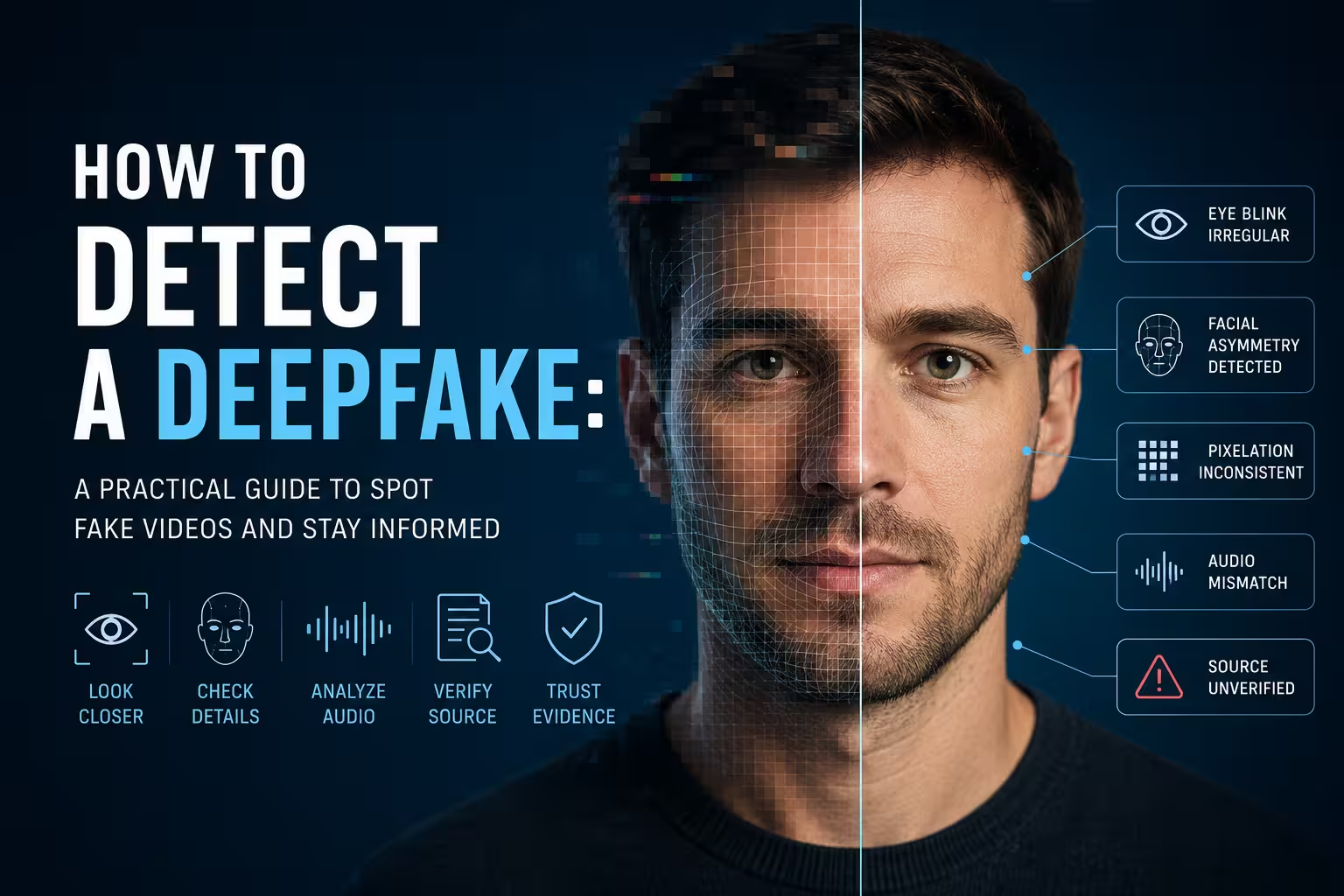

Test Yourself: Can You Spot the Deepfake?
2 portraits per round — 1 real photograph, 1 AI-generated face. No signup needed. See how you compare to the average 55% score.
What Is a Deepfake?
A deepfake is a video or image in which a real person's face has been replaced by another face using artificial intelligence. The word is a portmanteau of deep learning — the AI technique used — and fake.
The technology was first widely publicised in 2017, when Reddit users used FakeApp — an early face-swap tool based on autoencoders — to swap celebrities' faces into existing videos. By 2019, tools like DeepFaceLab had made convincing face swaps accessible to anyone with a consumer GPU. By 2024, commercial tools like Reface and HeyGen allow high-quality face swaps in seconds with no technical knowledge required.
Deepfakes are used for both legitimate and harmful purposes. Legitimate uses include film production (de-aging actors, recreating deceased performers), language dubbing, and entertainment. Harmful uses include non-consensual intimate imagery, political disinformation, financial fraud via CEO impersonation, and targeted harassment.
Why this matters in 2026: The 2024 US and UK elections both saw deepfake videos of political figures used in disinformation campaigns. The ability to spot a deepfake is no longer just a technical curiosity — it's a basic media literacy skill.
Deepfake vs AI-Generated Face — What's the Difference?
These terms are often confused. The distinction matters for detection — the artifacts you look for are different.
| Feature | Deepfake | AI-Generated Face |
|---|---|---|
| Person shown | A real person — misrepresented | Nobody — never existed |
| Technology | Face-swap (DeepFaceLab, SimSwap) | Text-to-image (Flux, Midjourney, DALL-E) |
| Key artifact | Face boundary / skin tone mismatch | Skin splotches / hair edge blur |
| Video version | Common and dangerous | Less common |
| Ease of detection | Harder (less studied) | Moderately hard |
Our Which Face Is Real? guide covers the 8 visual tells specific to AI-generated faces (StyleGAN, Flux, Midjourney). This page focuses on the additional artifacts introduced by the face-swap process.
8 Visual Tells That Reveal a Deepfake
These artifacts appear consistently in face-swap deepfakes across DeepFaceLab, SimSwap, commercial tools, and video-based diffusion models. Some are more visible in older outputs; all remain detectable in 2026 deepfakes with trained observation.
Face boundary blur — the most consistent deepfake tell
The seam between a swapped face and the original head is the hardest area for face-swap algorithms to get right. Look for a semi-transparent, slightly blurry halo around the perimeter of the face — particularly along the forehead, jaw, and where the face meets the ears. In real photographs, there is no visible boundary around a face. In a deepfake, the compositing step that blends the face into the scene typically leaves a 2–5 pixel zone of softness or colour inconsistency. This is most visible at high magnification, or when the subject turns their head and the boundary angle changes.
Zoom into the hairline and jaw. Run your eye along the edge of the face. Any softness, halo, or slightly different colour zone that doesn't correspond to lighting is a strong deepfake indicator.
Skin tone mismatch — face vs neck and ears
When a face is swapped, the source face comes from a different video or image with different lighting, camera settings, and colour grading. Even after colour correction, there is often a subtle but visible difference between the skin tone of the swapped face and the original person's visible neck, ears, or hands. The face may appear slightly warmer, cooler, more or less saturated, or have a different level of contrast than the surrounding skin. This mismatch is particularly visible in the transition zone between the jaw and the neck — look for a colour discontinuity where the face ends.
Compare the colour and tone of the face to the neck directly below the jaw. In a real photograph, these areas should be essentially identical in colour temperature. A visible difference is suspicious.
Lighting direction mismatch — face lit from the wrong angle
Every real photograph has a consistent light source — you can trace where the light is coming from by looking at the direction of shadows on the face, the position of catchlights in the eyes, and the highlights on the nose and cheekbones. In a deepfake, the source face was captured in different lighting conditions. Even after correction, the face often has highlights and shadows that don't match the rest of the scene. The give-away: the light on the face appears to come from a slightly different direction than the light on the shoulders, clothing, or background. Check which side of the nose has the highlight, and compare it to the shadow direction on the background.
Find the main light source from the scene (shadows, background lighting). Then check: are the face's highlights and shadows consistent with that direction? If they seem to come from a different angle, it's a red flag.
Eye blinking — too frequent, too rare, or asymmetric
This tell applies primarily to video deepfakes, but it's one of the most reliable. Human beings blink 15–20 times per minute in natural conditions, with each blink taking about 150–400 milliseconds. Early deepfake models (2018–2020) famously struggled to reproduce blinking naturally — many produced faces that almost never blinked. Modern models handle basic blinking better, but look for: one eye blinking more than the other (asymmetric blink); blinks that happen mid-sentence at inappropriate moments; or blink timing that feels robotic or slightly off-rhythm. The eye area is also where boundary artifacts are most visible when the face is in motion.
In video: count the blinks over 30 seconds and watch for asymmetry. One eyelid closing faster or more often than the other is unusual in real footage.
Temporal flickering — the face shifts while the body stays stable
In deepfake video, the face is generated frame-by-frame and composited back onto the original footage. Because each frame is processed independently (in most face-swap pipelines), there can be slight variations in face position, scale, or colour between adjacent frames. The result is a subtle flickering or shimmer on the face that is absent on the body and background. This is most visible when the video is paused and scrubbed frame-by-frame, or when viewed at half speed. Look for: the face appearing to subtly shift position by 1–2 pixels between frames; hair at the face edges flickering; or a slight texture or colour variation in the face region that doesn't appear elsewhere.
In any video deepfake suspect: play at 0.25x speed or use a video editor to step through frame by frame. Watch the face edge relative to the ears. Flickering that isn't present on the clothing or background is a strong signal.
Ear anatomy — mismatched, partial, or missing
Ears are frequently the least-well-reconstructed area in face swaps. The source face typically doesn't include the full ear, and the deepfake algorithm must either use the original person's ear or blend the two. Signs: an ear that looks different from the rest of the face in skin texture or colour; an ear that has a visible boundary on the inner edge where the swapped face ends; an ear that shows signs of being digitally reconstructed (too smooth, lacking the usual cartilage texture detail); or earrings that appear on the face side but not the ear side, or vice versa. If the subject is wearing earrings, compare both ears carefully.
Examine both ears. Are they the same skin tone as the face? Do they match in detail and texture? If one ear looks like it belongs to a different person, it may be a remnant of the original video.
Lip sync errors — mouth movement mismatched to audio
In video deepfakes that also alter what someone appears to be saying (sometimes called "audio-driven deepfakes"), lip sync is a common failure point. The generated mouth movements may not perfectly match the phonemes of the audio — a bilabial consonant (p, b, m) requires the lips to touch, but the deepfake mouth may not fully close. The transition between phonemes may be slightly too fast or too slow. The lip movement may also not match the expected animation for the visible teeth and tongue. This is hard to detect casually, but if something about a video speech feels "off" — particularly around the mouth — lip sync is worth examining closely.
Watch the mouth during hard consonant sounds (p, b, m, f, v). The lips should fully touch for "p" and "b" sounds. Any failure to close, or an over-short closure, suggests generated lip movement.
Signs a face is probably real — what to look for
The absence of deepfake artifacts doesn't confirm a video is real, but some elements are very hard to fake. Highly specific and consistent anatomy: visible pores or skin texture detail that is consistent at scale across the face and neck. Natural micro-expressions — real faces have subtle muscle movements between expressions that deepfake models flatten out. Consistent spectacle reflections: if the subject wears glasses, the reflection in the lenses should correspond to the background scene, and should shift naturally as the head moves. Highly detailed backgrounds with readable text that remains consistent between frames. And body language that is anatomically natural — deepfakes sometimes struggle with the connection between the swapped face and the body's head rotation.
If the subject wears glasses, watch the reflection in the lenses as their head moves. The reflection should shift realistically. A static or inconsistent reflection is an artifact.
Quick Deepfake Detection Checklist
Run through this in order — earlier items are the fastest to check and catch the majority of deepfakes. For video, the temporal tells (flickering, blinking) are easiest to see at 0.25× speed.
How Deepfakes Have Evolved (2019–2026)
Understanding the technology generations helps you know which tells still apply and which have been solved.
First-generation deepfakes (FaceApp / DeepFaceLab v1)
Characteristic artifacts: severe face boundary blurring; heavy skin texture artifacts (oil patches); visible face-to-head size mismatches; extreme blinking failures (subjects almost never blinked). These deepfakes are now trivially detectable by anyone familiar with the technology.
Second-generation (DeepFaceLab v2 / SimSwap / commercial apps)
Significantly improved boundary blending and colour matching. Blink handling became more natural. Remaining tells: subtle colour temperature differences between face and neck; blinking asymmetry under close observation; ear boundary artifacts; and face flickering at 1/4× playback speed. Many of the famous political deepfakes from this era fall in this category.
Third-generation (diffusion-based, commercial video APIs)
Modern tools like HeyGen, Pika Face Swap, and Runway face-swap produce outputs where boundary blending is nearly perfect under casual observation. The remaining tells require deliberate inspection: precise lighting physics analysis; temporal consistency across many frames; and forensic metadata examination. Audio-driven deepfakes now have near-perfect lip sync for many phonemes.
Famous Deepfakes That Fooled People
Knowing real-world examples helps anchor the visual tells. These cases are instructive because the detection artifacts described above were present in each — they were missed because viewers weren't looking for them.
President Zelensky "Surrender" Video (2022)
A deepfake video appeared to show Ukrainian President Zelensky instructing his troops to lay down arms. It was detected within hours. The primary tell: severe neck boundary artifacts — the face appeared to float slightly above the shoulders with a visible soft halo, and the neck skin tone was visibly different from the face. The head also moved in a slightly robotic way inconsistent with natural head movement.
Tom Hanks Dental Advertisement (2023)
A deepfake of actor Tom Hanks appeared to endorse a dental product — Hanks himself issued a public warning on social media. The video showed characteristic 2023-era artifacts: slight skin tone inconsistency between the face and neck; a brief flicker visible when the head turned; and eye movement that was slightly too regular (robotic blink timing).
CEO Voice Deepfakes (2019–ongoing)
Multiple financial fraud cases have involved voice-only and video deepfakes of company executives. In 2019, a UK energy company executive transferred £200,000 after receiving a deepfake voice call purportedly from the company's German CEO. Video deepfake CEO fraud cases are increasingly documented from 2023 onwards. These are particularly effective because the target expects to see and hear their boss — the social context suppresses critical evaluation.
Political Campaign Deepfakes (2024)
The 2024 US and EU election cycles both saw deepfake videos used in disinformation campaigns. Tools like DALL-E and HeyGen enabled even low-budget campaigns to produce convincing short video clips of political figures saying things they never said. Detection in these cases typically required frame-by-frame video analysis or forensic metadata examination.
Practice Makes the Difference
Research shows that applying detection strategies with feedback raises accuracy from 55% to ~65%. Our free quiz gives you immediate feedback on every answer — the fastest way to train your eye.
Frequently Asked Questions
What is a deepfake? ▾
A deepfake is a video or image in which a real person's face has been replaced by another face using AI — typically a public figure or celebrity. The term combines "deep learning" and "fake". Deepfakes differ from fully AI-generated faces (like those from Midjourney or Flux) because deepfakes superimpose a known person's likeness, while AI-generated faces depict people who never existed.
Can you spot a deepfake with the naked eye? ▾
For 2020-era deepfakes, yes — with training. For 2024–2026 deepfakes from tools like DeepFaceLab, SimSwap, or commercial face-swap apps, it is increasingly difficult. The most reliable tells are face boundary artifacts, skin tone inconsistencies between face and neck, and lighting direction mismatches. With practice, accuracy improves from 55% to around 70–80%.
How do deepfakes differ from AI-generated faces? ▾
A deepfake swaps the face of a real, identifiable person onto a different body or video. An AI-generated face (from tools like Flux or Midjourney) depicts a person who has never existed. Deepfakes show blending artifacts at the face boundary; AI-generated faces show consistency artifacts across the whole image.
What are the most reliable ways to detect a deepfake? ▾
The most reliable visual tells: (1) Face-to-neck skin tone mismatch. (2) Boundary blur — a soft halo around the face edge. (3) Lighting inconsistency — the face lit from a different direction than the scene. (4) Unnatural blinking — too frequent, too rare, or asymmetric. (5) Temporal flickering in video — the face flickers between frames while the body stays stable.
Are deepfake detector tools reliable? ▾
Automated deepfake detectors achieve 70–90% accuracy on 2022-era deepfakes, but accuracy drops on modern face-swap outputs. No automated tool is reliable enough to use as a definitive test in 2026. For high-stakes situations, forensic analysis of metadata, lighting physics, and facial geometry provides more reliable results.
Is it illegal to create deepfakes? ▾
It depends on the jurisdiction and use case. In the EU, non-consensual deepfakes that damage reputation or involve sexual content are covered under existing harassment and image-rights laws. The UK's Online Safety Act 2023 criminalises non-consensual intimate deepfakes. In the US, several states have passed deepfake-specific laws. Creating deepfakes for clearly labelled satire or artistic exploration is generally legal in most jurisdictions.
Which famous deepfakes have fooled people? ▾
Notable examples include the 2022 Ukrainian crisis deepfake of President Zelensky appearing to surrender (detected within hours due to neck artifacts); the 2023 viral Tom Hanks dental ad deepfake; and multiple political deepfakes used in the 2024 US election cycle. These cases highlight why deepfake detection skills matter for media literacy.
How can I get better at spotting deepfakes? ▾
The fastest way is deliberate practice with immediate feedback. Start by learning the 8 visual tells in this guide — particularly the face boundary and skin tone tells. Then practise with our free face quiz. A meta-analysis of 56 studies found that applying detection strategies raises accuracy from 55% to ~65%.
Related AI Detection Guides & Quizzes
Each guide covers a different type of AI-generated content.


Related
The same problem in still images, the tools that automate it, and where it does real damage.