Spot the Fake: Real Landmark or AI-Generated?
The Eiffel Tower, Taj Mahal, Colosseum — you've seen them a thousand times. But can you tell the real photo from three AI-generated copies?
Featured Landmarks
This quiz features 16 world-famous landmarks from across the globe. Each round shows you 4 images of the same landmark — find the real one.
Why Are Landmarks Hard for AI?
Famous buildings are both easy and hard for AI. The models have seen thousands of photos of these landmarks during training, so they know the general shape and style. But getting every architectural detail right — window patterns, stone textures, surrounding environment — is where AI still struggles.
Some landmarks are easier to fake than others. Simple, symmetric structures like the Brandenburg Gate look convincing as AI images. But complex buildings like the Sagrada Familia, with their intricate details, often reveal the AI.
Recognition Is Not Verification
Landmarks sit in the lower half of our image categories by raw accuracy — the live figures are above, and they move as people play. That ordering is the opposite of what almost everyone predicts. Buildings have hard edges, fixed proportions and countable elements; they ought to be the easiest thing in the world to verify. And in principle they are — the problem is that people do not verify them.
Recognition is not verification. When you look at a photograph of the Taj Mahal, the question your brain answers in the first fraction of a second is “is this the Taj Mahal?” — and the answer is yes for all four images, including the three fakes. That yes feels like confirmation, and most players stop there. With an unfamiliar building you have no such shortcut, so you actually look at it.
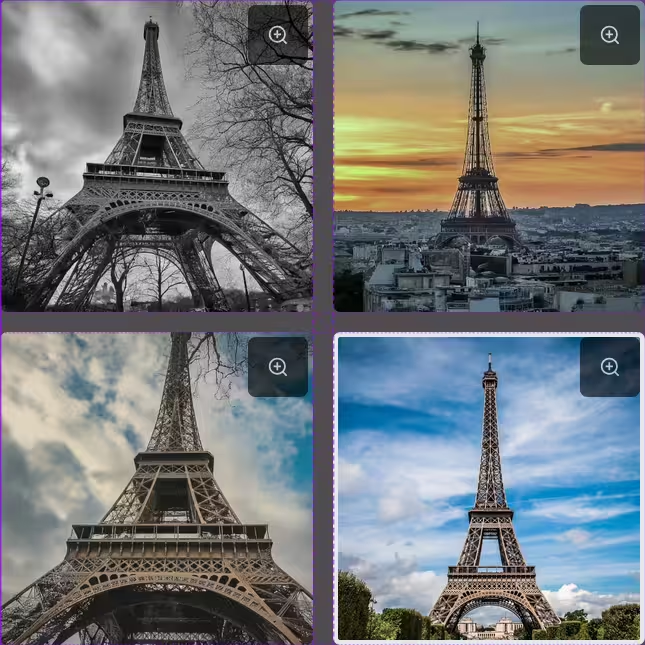
The practical consequence is uncomfortable but simple: the landmarks you know best are the ones you check worst. The Eiffel Tower example below exists because it is the most recognisable structure in the quiz, and therefore the one people get wrong most confidently.
Landmarks Give You Something Other Categories Don't
There is a compensation, and it is the reason this category rewards practice more than any other: a landmark has a correct answer that exists outside the image. A fox in long grass could plausibly look a hundred different ways. The Sydney Opera House has a fixed number of shells, the Leaning Tower has a fixed number of arcades, and Big Ben's clock face has fixed proportions relative to the tower.
This means you can prepare. Pick one countable, checkable feature per landmark and commit it to memory — not the whole building, one feature. The number of tiers. The shape of a window arch. Whether the columns are fluted. Then in a round, you are not judging whether an image looks right; you are checking a fact you already know against what is in front of you.
Generators are strong on overall silhouette precisely because that is what dominates their training data. They are weaker on the specific count, because a plausible-looking number of arches satisfies the objective just as well as the correct one.
How to Spot AI-Generated Buildings
- Count windows and arches — AI often gets repetitive patterns wrong
- Read long text, not short text — a crisp street sign proves nothing today, but an information board or plaque still dissolves up close
- Look at people in the scene — AI-generated crowds look unnatural
- Examine the skyline — surrounding buildings may have impossible geometry
- Study reflections — glass and water reflections often don't match the scene
Worked Example: The Eiffel Tower
The Eiffel Tower is a perfect trap, because everyone "knows" it — which makes it easy to accept a wrong one. Run these three checks before you commit:
- The lattice. The real tower is a precise iron lattice that follows a consistent curve from the four legs up to the tip. AI versions frequently muddle the ironwork halfway up, or let the two sides climb at slightly different angles.
- The count of levels. There are two clearly defined observation platforms below the summit. Fakes often add a phantom third tier or blur the platforms into the structure.
- The base and crowd. Look under the arches at the people and the Champ de Mars behind. Cloned, faceless figures and a smeared park are the giveaway — the tower itself is usually the last thing AI gets wrong.
The same approach — memorise one true detail, then check it — works for every landmark in the quiz.
How Players Actually Do Here
Across 8,691 rounds on 17photographs, players picked the real photo49% of the time. Because rounds in this category do not all show the same number of options, the baseline is 25% rather than a flat coin flip — which puts real performance at 1.95× chance, the category people read best.
From answers given on this site, recomputed nightly · last updated 14 October 2026. Within a visit only a player's first answer to a round counts; a replay in a new visit is not recognised, which nudges this figure slightly up. How this is measured · Per-model ratings
Frequently Asked Questions
Which famous buildings are in the quiz? ▾
The quiz features 16 world-famous landmarks including the Eiffel Tower, Taj Mahal, Golden Gate Bridge, Statue of Liberty, Big Ben, Sagrada Familia, Sydney Opera House, Cologne Cathedral, Leaning Tower of Pisa and more.
How do I spot AI-generated building photos? ▾
Key tells: inconsistent window or arch counts; garbled text on signs; unnaturally blurry or cloned crowds; surrounding buildings with impossible geometry; and reflections in glass or water that don't match the scene.
How many images are in each round? ▾
Each round shows 4 images of the same landmark — 1 real photograph and 3 AI-generated. Your task is to identify the single authentic photo.