Real Animal or AI-Generated? Test Your Eyes
AI can now generate stunningly realistic animal photos. Can you still tell a real lion from a fake one?
What's in This Quiz?
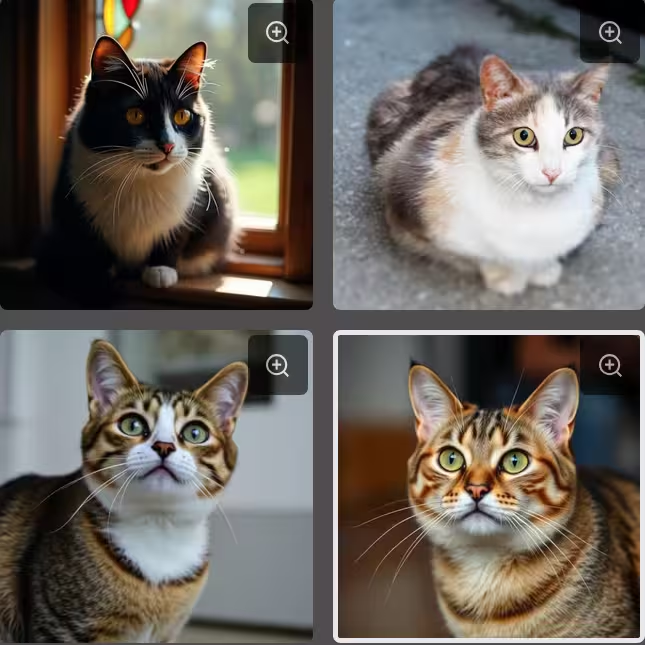
Each round shows you 4 animal images — one is a real photograph, three are generated by AI. Your challenge: find the authentic one.
The quiz features a wide variety of wildlife, including:
- Big cats — lions, tigers, leopards
- Birds — eagles, parrots, owls
- Marine life — dolphins, turtles, jellyfish
- Insects — butterflies, beetles
- Exotic animals — pandas, koalas, chameleons
- ...and more
Why Are AI Animal Photos So Convincing?
Animals are one of the most popular subjects for AI image generation. The fakes in this quiz come from FLUX.1 [schnell] and FLUX.1 [dev] (Black Forest Labs), Z-Image (Alibaba), Seedream 4.5 (ByteDance), Juggernaut Pro Flux (RunDiffusion) and GPT Image 1.5 (OpenAI), among others — all trained on enormous quantities of wildlife photography, and all remarkably good at it.
Fur texture, feather patterns, and natural lighting are areas where AI has improved dramatically — but it still makes mistakes. Subtle errors in anatomy, eye reflections, and background details can reveal the fake.
Tips for Spotting AI-Generated Animals
- Check the eyes — AI often generates uneven or unnaturally glossy eyes
- Follow one whole limb — not the toe count; watch for thickness changes where grass or branches pass in front
- Look at the fur pattern — real fur has natural irregularities, AI tends to be too uniform
- Study the background — blurry, melting, or impossible backgrounds reveal AI
- Check the ears and whiskers — these fine details are hard for AI to get right
Anatomy First, Background Second
Do not reject an image simply because it is unusually sharp or dramatic—real wildlife photographers use long lenses, fast shutters and careful editing. Start with structures that have fixed biological rules. Follow each leg from body to paw, check whether wings attach in the right place, and compare the direction of both eyes. Then inspect how the animal meets the ground, water or branch supporting it.
The background is supporting evidence, not an automatic answer. Natural depth of field can blur grass and foliage, but it should do so consistently by distance. Synthetic images more often merge a whisker into the background, repeat a leaf pattern, or change texture abruptly around the animal's outline. Looking for several independent clues is more reliable than trusting one old “AI tell.”
Animals Are Harder Than They Look
Players beat chance in this category — the measured figures are above — but by less than almost anyone predicts before they play. Animals feel like they should be the easy one.
The intuition that animals should be easy comes from an outdated picture of what AI struggles with. Fur used to smear, feathers used to repeat, eyes used to look like glass marbles. Those are largely solved. What remains is harder to notice precisely because it is not a texture problem: it is about how a body relates to the world around it.
Wildlife photography also works against you. Real wildlife shots are often taken with long lenses at wide apertures, which produces exactly the creamy, isolated-subject look that reads as “too perfect” to an untrained eye. Rejecting an image for being beautifully shot is one of the most common ways players talk themselves into the wrong answer.
Worked Example: A Fox in Long Grass
Four images, all sharp, all with convincing fur. This is the sequence that resolves it fastest:
- Follow one leg from shoulder to paw. Not a leg count — the whole limb. Joints should bend in one direction only, and the leg should stay the same thickness as it passes behind grass. AI limbs frequently change width where something occludes them, or acquire an extra bend.
- Check where the animal meets the ground. Paws should displace what they stand on: grass bent, snow compressed, dust disturbed. A fox that stands on the grass rather than in it is the single most common failure in this category.
- Compare the two eyes. Not for beauty — for agreement. Both should reflect the same light source from the same angle, and both pupils should be the same shape. Models handle a single eye well and a pair less well.
- Trace the outline against the background. Where fur meets grass, look for whiskers that dissolve into a blade of grass, or a rim of blur that follows the animal's shape rather than the actual distance.
- Scan the grass itself for repetition. Natural vegetation is irregular. Generated vegetation often contains the same clump twice, mirrored or slightly rotated.
Notice that none of these are “count the toes.” Extra digits do still appear occasionally, but betting on them means losing far more often than winning — see the tells that stopped working.
Landscapes, weather and plants follow the same logic but reward different checks — light direction, horizon geometry and how water meets rock. Those are collected in our nature quiz guide.
How Players Actually Do Here
Across 17,876 rounds on 27photographs, players picked the real photo70% of the time. Because rounds in this category do not all show the same number of options, the baseline is 25% rather than a flat coin flip — which puts real performance at 2.78× chance, the category people read best.
From answers given on this site, recomputed nightly · last updated 14 October 2026. Within a visit only a player's first answer to a round counts; a replay in a new visit is not recognised, which nudges this figure slightly up. How this is measured · Per-model ratings
Frequently Asked Questions
What animals are in the quiz? ▾
The quiz features a wide variety of wildlife: big cats (lions, tigers, leopards), birds (eagles, parrots, owls), marine life (dolphins, turtles, jellyfish), insects (butterflies, beetles), and exotic animals (pandas, koalas, chameleons).
What gives away AI-generated animal photos? ▾
The reliable tells are relational rather than anatomical: how the animal meets the ground (paws resting on grass instead of pressing into it), whether both eyes reflect the same light source from the same angle, limbs that change thickness where grass or branches pass in front of them, and repeated clumps in the vegetation. Counting toes rarely works any more — current models get digits right in most outputs.
How many images are in each round? ▾
Each round shows 4 animal images — 1 real wildlife photograph and 3 AI-generated. Your task is to identify the single authentic photo.