Real Nature Photo or AI-Generated?
Mountains, beaches and forests are easy for image generators to imitate at a glance. The challenge is finding the details that still obey the real world.
Four images per round · One real photo · Free · No signup
How the Nature Quiz Works
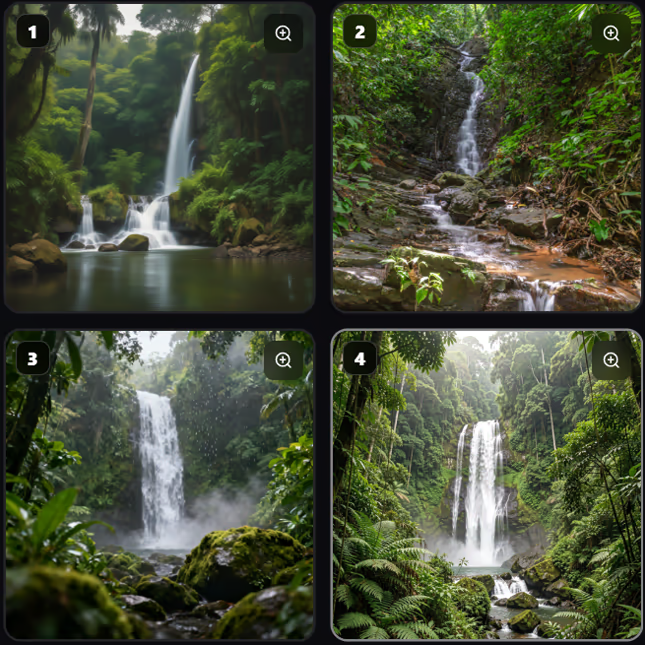
Every round contains one real nature photograph and three AI-generated alternatives. Pick the authentic image before revealing the source and the image-model labels.
The subjects range from alpine peaks and tropical beaches to rivers, deserts, cloud formations, forests and waterfalls. That variety matters: the clue that exposes a fake ocean is not always the clue that exposes a fake woodland.
Current rounds include outputs from models such as FLUX, Seedream, Kling Image, Imagen and Stable Diffusion. The gallery changes as new quiz sets are added, so the task tests modern generators rather than one fixed model.
Why AI Landscapes Look So Convincing
Landscape photographs contain many forgiving textures. Leaves, rocks, clouds and waves do not have one exact shape, so a generated scene can feel plausible even when no individual detail is quite right. Dramatic lighting and familiar postcard compositions make that first impression even stronger.
The best way to check a scene is to follow relationships rather than hunt for a single odd pixel. Light should travel in one direction, reflections should correspond to what is above them, rivers should flow through connected terrain, and detail should change consistently with distance.
Six Clues for Spotting an AI Landscape
🌿 Repeating vegetation
Look for cloned leaf clusters, identical trees or foliage that dissolves into a decorative texture.
💧 Water and reflections
A reflection should match the object, light and viewing angle. AI water often invents a second scene.
☀️ Conflicting light
Compare highlights and shadows across rocks, trees and clouds. Multiple sun directions are a strong warning.
🏔️ Broken terrain
Trace ridgelines, roads and rivers. Generated geography may merge, stop abruptly or lead nowhere.
🌫️ Inconsistent distance
Real atmospheric haze increases with distance. AI scenes sometimes make the horizon sharper than the foreground.
🖼️ Too-perfect composition
Symmetry and saturated sunsets are not proof, but they are a reason to slow down and verify physical details.
Use More Than One Clue
A blurred background, vivid color or cinematic sky can all occur in a real edited photograph. Treat each clue as evidence, not a verdict. The strongest answers combine two or three independent checks—for example, a reflection that disagrees with the sky, repeated vegetation and a river that crosses the terrain impossibly.
This is also why the quiz reveals the answer after each round: compare your reasoning with the source label and update the visual rules you trust.
Nature Is the Category With No Right Answer
Most of our quizzes give you something to check against. A landmark has a fixed number of arches. A person has anatomy that follows rules. A car has a badge with a correct shape. In each case you can hold the image up against knowledge you already possess and see whether it agrees.
A landscape gives you none of that. There is no canonical mountain. A ridge can take any profile, a coastline any shape, a cloud any form — and every one of them is plausible, because somewhere on Earth it probably exists. The usual method of “does this match what I know it should look like” has nothing to grip.
What remains is physics. A landscape is not free-form: light travels in straight lines from one source, water finds the lowest path and sits level, atmosphere scatters more light the further away something is, and erosion carves terrain in continuous shapes rather than isolated lumps. A generator reproduces the look of these effects convincingly while frequently getting the relationships between them wrong.
So the question to ask here is different from every other category. Not “is this what it should look like?” but “could this scene physically exist?” Those are separate questions, and only the second one is answerable from a landscape photograph.
Worked Example: A Mountain Lake at Sunrise
The classic postcard scene, and a favourite of image generators: still water, peaks behind, warm light. All four images look beautiful. This is the order that resolves it fastest, and none of the steps require knowing the location:
- Compare the reflection to the thing reflected. Not for beauty — line by line. The reflected ridge should be the same ridge, inverted, with the same notches in the same order. AI water very often produces a reflection that is a mountain rather than that mountain.
- Find the sun, then check every shadow agrees. Pick the brightest edge on a peak and work out where the light is coming from. Then look at trees on the shore, rocks in the foreground and the lit side of the clouds. One object lit from the wrong side settles the round.
- Check that the water is level. It sounds trivial, but a lake surface is a perfect horizontal plane. Where it meets the shore on the left and on the right, it should be at the same height. Generated water occasionally tilts, or meets the bank at inconsistent heights.
- Follow the haze with distance. Further ridges should be paler, softer and lower in contrast than nearer ones, and the progression should be smooth. A sharp, saturated distant peak in front of a hazy nearer one is physically impossible.
- Trace where water enters and leaves. A lake has inflow and outflow, and the terrain around it slopes toward it. Generated landscapes sometimes place water in a bowl with no catchment, or run a river along a ridge instead of a valley.
Note what is not on the list: judging whether the scene is “too beautiful.” Real landscape photographers wait years for this light and then edit the result carefully. Dramatic is not evidence.
How Players Actually Do Here
Across 12,934 rounds on 35photographs, players picked the real photo52% of the time. Because rounds in this category do not all show the same number of options, the baseline is 25% rather than a flat coin flip — which puts real performance at 2.07× chance, the category people read best.
From answers given on this site, recomputed nightly · last updated 14 October 2026. Within a visit only a player's first answer to a round counts; a replay in a new visit is not recognised, which nudges this figure slightly up. How this is measured · Per-model ratings
Frequently Asked Questions
How many images are in each round?
Four: one real nature photograph and three AI-generated images. Choose the single authentic photo.
Which nature scenes are included?
Mountains, beaches, forests, rivers, waterfalls, deserts, coastlines, meadows, clouds and other outdoor landscapes.
Is dramatic lighting proof that an image is AI?
No. Real photographers use long exposures, filters and editing. Verify physical relationships such as shadows, reflections, terrain and depth instead of judging style alone.