
AI Cars Quiz: Real Photo or AI Fake?
DALL-E, Stable Diffusion, or a real photo? AI can generate incredibly realistic car images. Can you spot which one is actually real?
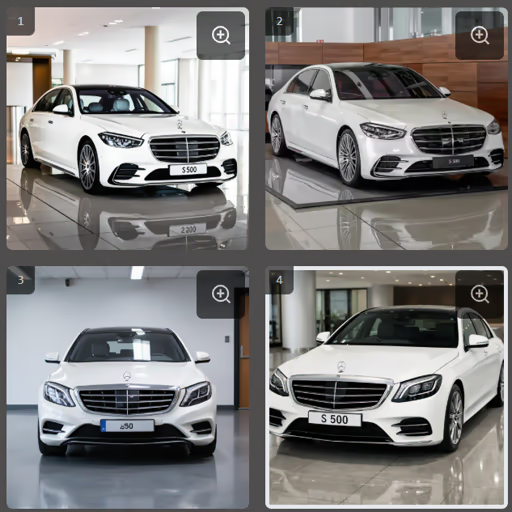
Why Cars Are a Special Case for AI
A car is a stress test for image generators because it demands three hard things in a single frame. First, reflective hard surfaces: paint, chrome and glass must mirror the surroundings consistently across every panel. Second, exact geometry — enthusiasts know precisely what a 911's roofline or a Ferrari's haunches should look like, so a proportion that's slightly off is instantly wrong. Third, text: badges, model names and number plates are tiny bits of writing, and writing is where diffusion models are weakest.
That combination means a fake can be 95% convincing and still fall apart the moment you look at the emblem on the grille.
Worked Example: A Red Ferrari on a Coast Road
Four glossy red Ferraris, one real. This is the exact sequence I'd run:
- The badge. Zoom to the prancing-horse emblem and any "Ferrari" script. Real logos are crisp and correctly proportioned; AI tends to melt, smear or subtly deform them.
- The wheels. Count the spokes on both visible wheels — AI often gives the two wheels different spoke counts or bends the geometry. Then check whether the brake caliper sits behind the spokes or appears to float.
- Reflection continuity. Follow a single reflection — say the horizon line — across the door and into the front wing. On a real car it flows continuously and breaks logically at panel gaps. AI reflections often "jump" or show a different scene on each panel.
- The number plate. Real plates read as coherent characters. AI plates dissolve into invented glyphs — a dead giveaway if the shot is close enough to see them.
Notice these are checks you can't reuse on a plate of food or a portrait — they're specific to hard-surfaced, badge-bearing machines.
Tells That Only Apply to Vehicles
- Badges & logos — the number-one tell; manufacturer emblems come out warped or asymmetric.
- Wheel & spoke geometry — mismatched spoke counts between wheels, ovalised rims, or a caliper in the wrong place.
- Panel-gap reflections — real paint reflects one coherent environment; AI often breaks the reflection across doors and wings.
- Light clusters — the internal lenses of LED headlights and taillights have precise repeating patterns AI struggles to reproduce.
- Ancillaries — door handles, wing mirrors and wipers are sometimes missing, duplicated or fused into the body.
How the Models Handle Cars
With "Show model names" switched on, the cars category is a good way to learn each generator's weak spot:
- DALL-E 3 — nails the overall silhouette, but badge detail and grille meshes are often where it slips.
- Stable Diffusion — can produce genuinely photoreal bodywork, yet frequently botches wheels and reflections.
- Google Imagen — strong on lighting and paint depth, occasionally distorts wheel proportions and plate text.
Cars in rotation include Ferrari, Porsche 911, Lamborghini, Ford Mustang, Rolls-Royce and Bugatti.
How Players Actually Do Here
Across 9,898 rounds on 21photographs, players picked the real photo52% of the time. Because rounds in this category do not all show the same number of options, the baseline is 25% rather than a flat coin flip — which puts real performance at 2.08× chance, the category people read best.
From answers given on this site, recomputed nightly · last updated 14 October 2026. Within a visit only a player's first answer to a round counts; a replay in a new visit is not recognised, which nudges this figure slightly up. How this is measured · Per-model ratings
Frequently Asked Questions
Why are cars hard for AI to fake convincingly? ▾
Cars combine three things AI finds difficult at once: hard reflective surfaces that must mirror the environment coherently, precise brand-specific geometry, and small text on badges and plates. A single panel that reflects the wrong scene, or a warped logo, gives the fake away.
What is the fastest tell on an AI-generated car photo? ▾
Badges and text. Emblems and number plates are the first place AI breaks down — logos come out garbled or melted and plate characters turn into nonsense. Wheels are the second-fastest check: count the spokes and look for a floating brake caliper.
Which AI models create the fake car images? ▾
The quiz pairs real photographs with fakes from DALL-E 3, Stable Diffusion and Google Imagen. Enable "Show model names" before you start to see which model produced each image after every round.
More Quiz Categories
Want the full method? Read our guide to detecting AI-generated images. Moving vehicles are a different problem — wheels, reflections and road contact have to stay consistent frame after frame. Our guide to the vehicle video quiz covers what to watch for there.