Real or AI Vehicle Video?
Cars, trains, planes and boats have rigid shapes and predictable motion—exactly the details that make synthetic footage look convincing until one frame breaks the rules.
Two clips per round · One real · Free · No signup
How the Vehicle Video Quiz Works
Each round places two short clips side by side. One is real footage and one was generated from a matching text prompt. Watch both loops, choose the authentic clip and then inspect the revealed model label.
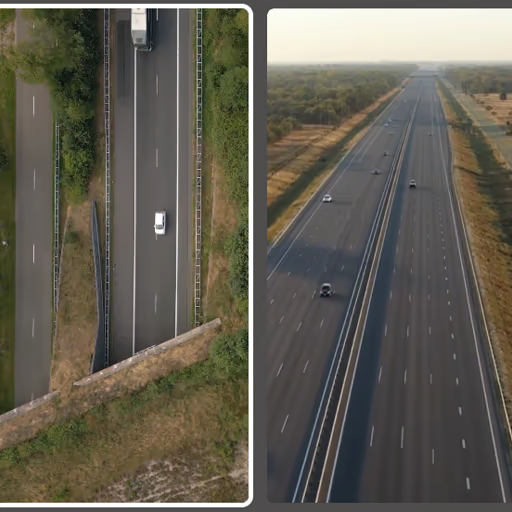
Current scenarios include highway traffic, an approaching train, a passenger-plane wing, a sailing boat and a cycling race. The synthetic opponents in the current set come from Sora 2 and Kling 3.0.
Do not decide from a single attractive frame. Video gives you time as evidence: follow the same wheel, window, reflection or person for several seconds and check whether it remains physically consistent.
Why Vehicles Are a Good AI Video Test
Vehicles combine hard geometry with continuous movement. Body panels, windows, rails, wings and wheels must keep the same proportions while the camera and background move. A model can render one convincing frame but still struggle to preserve all of those relationships through time.
Reflective surfaces add another constraint. Real paint and glass mirror the environment according to camera angle, while generated reflections may slide independently, show objects that are not present or change abruptly between frames.
Six Clues for Spotting an AI Vehicle Clip
🛞 Wheel rotation
Compare spin with speed. AI wheels may rotate inconsistently, wobble or change spoke patterns.
🛣️ Contact with the ground
Tires, rails and landing gear should meet the surface precisely without floating, sinking or sliding sideways.
✨ Moving reflections
Reflections should change smoothly with the environment. Watch for highlights that stick to the camera or jump.
📐 Rigid geometry
Doors, windows, rails and wings should not bend, breathe or slowly change shape from frame to frame.
🌆 Background flow
Road markings, buildings and scenery should move at a speed consistent with the camera and vehicle.
🚴 People and controls
Drivers, cyclists and passengers must grip, steer and move naturally without fused hands or changing equipment.
A Better Way to Watch
Start with the largest mechanical relationship: does the vehicle move through the scene at a believable speed? Then pick one stable feature—a wheel hub, window edge or wing tip—and track it across the full loop. Finally check secondary evidence such as reflections, signs and background objects.
This order prevents one dramatic artifact from dominating your judgment. Compression, rolling shutter and motion blur can all appear in authentic footage, so the best answer is supported by multiple inconsistencies that share the same cause.
The One Category Where You Can Check the Maths
Most detection comes down to judgement: does this fur look right, is that reflection plausible, would a person stand like that. Vehicles are different, because their motion is not a matter of taste. A wheel of a given size rolling at a given speed turns at exactly one rate. A train approaching at a constant speed grows in the frame along a predictable curve. A plane wing flexes within known limits.
That makes vehicle clips the closest thing to an objectively checkable round on this site. You are not asking whether something looks convincing — you are asking whether two observable quantities agree with each other. Speed against wheel rotation. Distance travelled against how much the background shifts. Turn radius against the angle of the front wheels.
Generators are strong at each of these individually and weak at keeping them consistent with one another, because nothing in their training forces a physical relationship between separately rendered parts of a frame. A car can slide sideways while its wheels turn straight ahead and every single frame will still look photographic.
Worked Example: Traffic on a Highway
Two clips, both showing cars passing on a motorway from an elevated angle. Both look like dashcam or drone footage. Here is the order to work through — and notice how little of it is about how the cars look:
- Pick one car and follow it out of frame. Not a glance — the whole traversal. It should move at a constant speed relative to the road surface, stay in its lane, and keep the same size relationship to the vehicles around it. Generated traffic frequently has one car that drifts in speed for no reason or subtly changes proportion as it crosses the frame.
- Watch where tyres meet tarmac. This is the single most productive check in vehicle clips. Contact should be continuous and the shadow directly beneath should move with the car. Cars that hover a few centimetres, or whose shadow lags behind, are the most common failure.
- Check lane markings passing under the vehicles. The dashes should flow at a rate consistent with the cars' speed, stay evenly spaced, and pass behind the cars rather than through or over them. Road markings are a texture to a generator, and textures forget about occlusion.
- Compare two cars in different lanes. If one is overtaking, the relative speed should stay believable across the loop. Generated scenes sometimes have vehicles that pass each other at physically absurd closing speeds without any visual sense of it.
- Look at the road surface itself over time. Asphalt texture, repairs and stains should scroll past as fixed features of the world. If the surface shimmers or regenerates as it moves, the model is inventing it frame by frame.
A Trap: Wheels That Spin Backwards
One warning about the wheel-rotation check, because it produces more false accusations than any other clue. In real footage, wheels routinely appear to slow down, stop, or rotate backwards while the car is clearly moving forwards. This is the stroboscopic effect: when the spokes advance by almost exactly one spoke-spacing between two frames, the camera records them in nearly the same position, and your eye reads the small difference as backward motion.
It is a property of sampling a rotating object at a fixed frame rate, and it has been visible in film since the earliest westerns — which is why it is sometimes called the wagon-wheel effect. It is not evidence of anything synthetic.
What is suspicious is a wheel whose rotation direction or speed changes without the car's speed changing, or one whose spoke pattern reorganises between frames. Those cannot be explained by frame rate. The distinction matters: a smooth, consistent backward-looking spin is physics, while an unstable one is a generator losing track of what it drew a moment earlier.
Frequently Asked Questions
Which vehicles appear in the quiz?
Current rounds include highway traffic, a train, a passenger plane, a sailing boat and a cycling race.
Which AI models generated the fake clips?
The current vehicle set uses Sora 2 and Kling 3.0. The lineup can change as new rounds are added.
Is motion blur evidence of AI video?
Not by itself. Real cameras produce motion blur and rolling-shutter distortion. Look for geometry, reflections or contact points that change inconsistently across several frames.