
AI People Quiz: Real Person or AI-Generated?
Modern AI models generate images of people — portraits, couples, street scenes — that are nearly impossible to distinguish from real photos. Each round: 4 images — 3 AI-generated, 1 real photo. Click the real one.
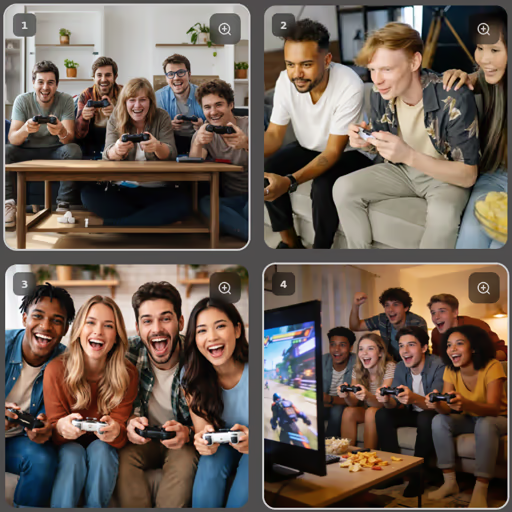
Why AI Images of People Are So Hard to Detect
Modern models like Flux, Seedream 4.5 and DALL-E 3 generate portraits that look strikingly real. But the People quiz goes beyond single portraits — it includes everyday situations: couples, groups, street scenes, people at work.
These scenarios force AI to get clothing, backgrounds, lighting, shadows and human interaction all right at the same time — which is exactly where the cracks still appear.
AI Models Used in This Quiz
Each round contains one real photo and three AI-generated images from different models:
- Juggernaut Pro Flux — excellent skin texture and lighting, often too polished
- Kling IMAGE 3.0 Omni — strong composition, occasional artifacts in backgrounds
- Z-Image — highly realistic, struggles with group interactions
- DALL·E 3 — consistent quality, sometimes over-saturated colors
- Seedream 4.5 — sharp detail, hands and fingers occasionally off
Enable "Show model names" before starting to reveal which AI generated each fake after every round.
How to Spot AI-Generated Images of People
- Hands doing something — counting fingers no longer works, but hands still fail when they grip, overlap or touch another person
- Jewelry and accessories — earrings, necklaces and glasses frequently have asymmetry or incorrect detail
- Fabric texture — clothing folds and wrinkles often look too uniform or physics-defying
- Background coherence — people in AI images sometimes don't cast shadows or fit the scene's perspective
- Eye reflections — real eyes reflect a consistent light source; AI reflections often don't match
- Group interactions — body language between people in AI images often looks posed or misaligned
How the People Quiz Is Sourced and Reviewed
The authentic option in every round is a licensed photograph, not an image that merely “looks real.” The three synthetic alternatives are generated for the same described scene and retain their model label in the quiz data. This matters most for people scenes: comparing a studio portrait with an AI street photo would test photographic style rather than authenticity.
Before a round is published, the four options are checked for matching subject matter, comparable image quality and an unambiguous source label. We also avoid relying on face quality alone. Current models often render a convincing face while failing in secondary evidence such as overlapping hands, repeated background people, inconsistent accessories or impossible contact between bodies and objects.
Why Studying the Face Doesn't Help
Players do beat chance in this category — the measured figures are above — but by a smaller margin than the effort they put in would suggest, and people almost always expect to do better here than they actually do.
The reason is not that faces are unbeatable. It is that faces are the part everyone checks, and the part models have most thoroughly solved. Skin pores, hair strands, catchlights in the eyes — all of these are now rendered convincingly enough that a careful look at a face usually confirms nothing either way. Players who spend their attention there come away with a confident feeling and a coin flip.
What still fails is everything around the person. That is why this quiz uses couples, groups and street scenes rather than isolated portraits: a single figure gives a generator one thing to get right, while two people in contact give it a relationship to get wrong.
Worked Example: Two People Sharing a Table
A café scene, two people mid-conversation. Faces look fine in all four images — as they usually will. This is the order that actually resolves the round:
- Find where the two bodies interact. A hand on a shoulder, elbows on the same table, one person leaning toward the other. Generators place figures convincingly but negotiate the space between them badly: an arm that rests on a surface without deforming it, or a shoulder that occupies the same space as the chair behind it.
- Follow one object from hand to table. A cup, a phone, a fork. Check that the fingers actually wrap it, that the object casts a shadow onto the surface, and that the surface is where the shadow says it is.
- Count people in the background — then count them again. Background figures are cheap for a model to render and easy to get wrong: duplicated faces, a person with no legs behind a table, a waiter whose apron merges into a wall.
- Check accessories for symmetry. Glasses with mismatched arms, one earring of a pair, a watch strap that changes width. These survive when faces do not, because they are small, structured objects the model treats as texture.
- Read any text last. A menu, a sign, a logo on a cup. If there is legible text it is often the fastest answer of all — but in people scenes there frequently is none, which is why it comes at the end rather than the start here.
Note what is missing from that list: counting fingers. It was the defining AI tell for years and current models handle hands correctly in most outputs — we wrote about the tells that stopped working separately. Hands are still worth looking at, but only where they are doing something.
How Players Actually Do Here
Across 15,217 rounds on 33photographs, players picked the real photo69% of the time. Because rounds in this category do not all show the same number of options, the baseline is 25% rather than a flat coin flip — which puts real performance at 2.74× chance, the category people read best.
From answers given on this site, recomputed nightly · last updated 14 October 2026. Within a visit only a player's first answer to a round counts; a replay in a new visit is not recognised, which nudges this figure slightly up. How this is measured · Per-model ratings
Frequently Asked Questions
Can you tell if a photo of a person is AI-generated?
Yes, but it takes practice. Key tells include distorted hands and fingers, clothing that defies physics, people who don't cast proper shadows, misaligned body language in group shots, and backgrounds that don't fit the scene's perspective.
Why are AI-generated images of people so hard to detect?
Modern AI models like FLUX, DALL·E 3 and Kling IMAGE have largely solved older problems like distorted faces. The challenge now lies in everyday details: clothing folds, group interactions, lighting consistency across a full scene — areas where AI still slips up.
What AI models generate the fake people images in this quiz?
The quiz uses Juggernaut Pro Flux, Kling IMAGE 3.0 Omni, Z-Image, DALL·E 3 and Seedream 4.5 — all paired with real photographs.
More Quiz Categories

Learn the 8 specific visual tells that reveal AI-generated faces — from skin splotches and asymmetric glasses to hair edge artifacts. Includes a face-vs-face quiz and StyleGAN vs diffusion model comparison.
Read: Which Face Is Real? Detection Guide →