Real or AI Animal Video?
AI video models can now generate stunningly realistic animal footage — fur, motion, environment and all. Two clips per round — only one is real. Can you spot the difference?
Free · No account required · Unlimited rounds
How the Animal Video Quiz Works
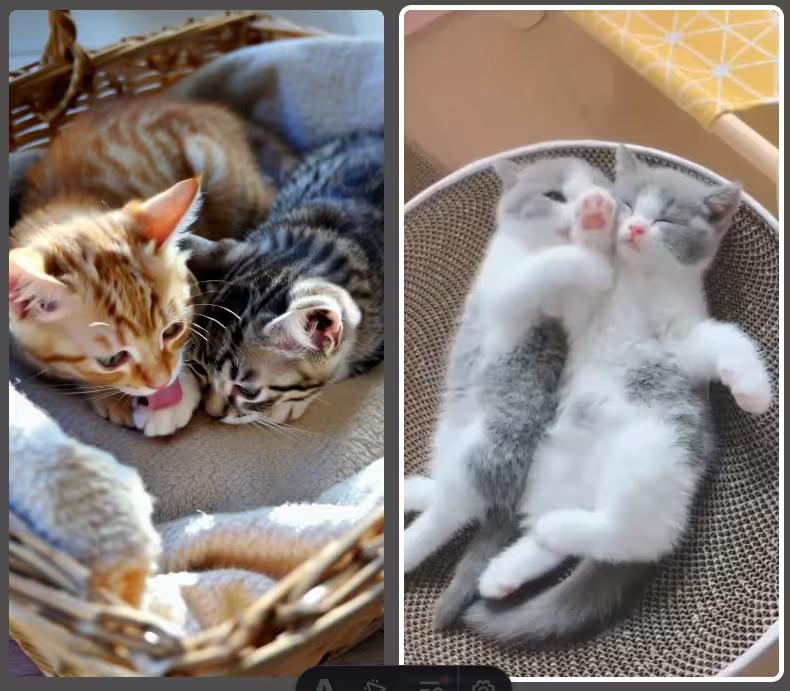
Each round shows you two short video clips side by side — one is real wildlife footage captured by a camera, the other was generated entirely by an AI model from a text prompt. Your job: pick the real one.
After you answer, both videos keep looping so you can study exactly what gave the AI away — or what made it so convincing. Scores are tracked so you can see how you improve over time.
The difficulty ranges from obvious tells to near-perfect fakes. Some clips will fool even experienced viewers — that is intentional. The goal is to train your eye for the subtle artifacts that current AI models still struggle to hide.
Which AI Video Models Are Used?
The quiz features the most advanced AI video generators available, all tested on wildlife subjects:
Currently one of the most realistic text-to-video models for animals. Kling 3.0 excels at fur texture, natural movement patterns, and environmental interaction — water splashing, grass moving underfoot, wind in feathers. Extremely difficult to detect on first viewing.
OpenAI's flagship video model handles complex scenes with multiple animals, realistic physics, and long-range temporal consistency. Particularly strong on birds in flight and underwater sequences.
Google's Veo 3 produces cinematic-quality wildlife footage with exceptional lighting and color grading. The model has a tendency toward documentary-style framing that can make it especially convincing.
ByteDance's model produces smooth, natural-looking animal motion with high temporal consistency. Strong on large mammals and birds, with occasional subtle artifacts in fast-motion sequences.
Want to see these models compared side by side? See the full AI video model comparison →
How to Spot AI-Generated Animal Videos
Even the best AI models leave traces. Here is what to look for:
AI-generated fur tends to shimmer, morph, or have a subtle plastic quality during movement. Real fur has individual strand variation and reacts differently to light at every frame.
AI animals often have overly symmetrical, glassy, or too-perfect eyes. Real animal eyes have micro-movements, irregular reflections, and blink patterns tied to environmental stimuli.
Watch how the animal interacts with its surroundings. Real animals displace grass, create ripples in water, and leave shadows that match the light source. AI often gets these physics slightly wrong.
AI backgrounds can drift, tile, or shift in unnatural ways — especially at the edges of frame. Real wildlife footage has camera shake, consistent depth of field, and natural background movement.
Real animals have weight, inertia, and fatigue. AI movement is often too smooth, too perfectly timed, or lacks the micro-adjustments that come from an animal reacting to its real environment.
Why AI Animal Video Detection Matters
AI-generated wildlife footage is already appearing in advertising, social media, and educational content — often without disclosure. In 2025 and 2026, viral "wildlife moments" shared across platforms have turned out to be AI-generated.
Developing the skill to distinguish real footage from synthetic video helps you evaluate content critically, understand the current state of AI video technology, and avoid sharing misinformation — even unintentionally.
This quiz is designed to make that learning process fast, fun, and genuinely challenging. Most first-time players score around 60-65% — the same as a coin flip on the hardest rounds. With practice, accuracy improves significantly.
Frequently Asked Questions
Can AI really generate realistic animal videos? ▾
Yes. Models like Kling 3.0, Sora 2 and Veo 3 can generate wildlife footage so realistic that most people cannot distinguish it from real video on first viewing. Fur texture, natural movement, and environmental interaction are all convincingly simulated — though subtle artifacts remain if you know where to look.
Is this quiz free to play? ▾
Yes, completely free. No account required, no ads, no limits. You can play as many rounds as you like directly in your browser on desktop or mobile.
What is the average score? ▾
Most first-time players score around 60-65%. After a few rounds of studying what to look for, scores typically improve to 75-80%. Getting above 90% consistently means you have developed a genuinely sharp eye for AI video artifacts.
Which animal is hardest for AI to generate convincingly? ▾
Complex fur patterns (tigers, leopards) and fast-moving animals (birds in flight, fish underwater) remain challenging for AI. Animals with highly distinctive movement — like snakes, insects, or jumping cats — also tend to expose AI limitations more clearly than slow-moving large mammals.
Are there other video quiz categories? ▾
Yes — you can also test yourself on AI-generated videos of people (deepfakes) and sports footage. Each category has different tells and difficulty levels.