Real or AI Sport Video?
AI video models can now generate realistic sports footage complete with athlete movement, crowd noise, and physics. Two clips per round — only one is real. Can you tell which?
Free · No account required · Unlimited rounds
How the Sport Video Quiz Works
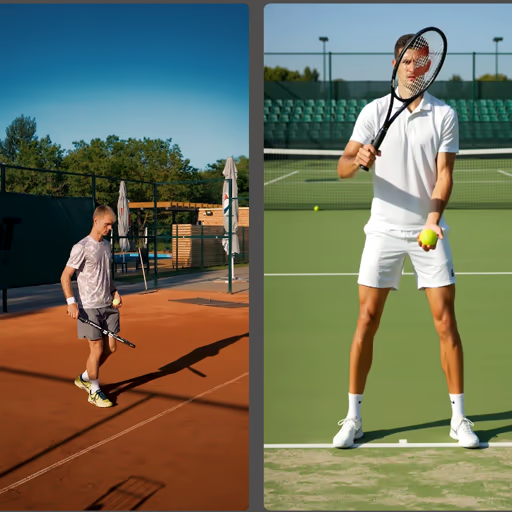
Each round shows you two short video clips side by side — one is real sports footage, the other was generated by an AI model from a text prompt. Pick the real one.
After you answer, both videos keep looping so you can study what gave the AI away. Sports footage is uniquely challenging because AI must simulate both human biomechanics and real-world physics simultaneously.
The quiz covers a range of sports — from football and basketball to tennis and athletics — each with its own set of AI artifacts to discover.
Which AI Video Models Are Used?
The quiz features the leading text-to-video models tested specifically on sports subjects:
Kuaishou's flagship model produces highly realistic athlete motion, fast-paced action, and crowd scenes. Strong at body mechanics and continuous action sequences — one of the hardest sport generators to detect.
OpenAI's Sora 2 generates coherent scenes with realistic physics — especially convincing on ball trajectories and player movement. Struggles most with fast multi-player interactions and referee positioning.
Google's Veo 3 excels at broadcast-style sports framing with accurate stadium lighting and crowd depth. Its main weakness is fine detail on athlete faces and fast-motion limb rendering.
ByteDance's model produces smooth, natural-looking athlete motion with high temporal consistency. Particularly strong at individual sports like tennis and athletics.
Curious how these models compare? See the full AI video model comparison →
How to Spot AI-Generated Sports Footage
Sports videos expose AI weaknesses that calmer footage hides. Here is what to watch for:
Ball trajectory, spin, and bounce are among the hardest physics for AI to simulate accurately. Watch for balls that curve too perfectly, bounce at the wrong angle, or appear to pass through surfaces briefly.
AI-generated crowds are often blurry, repeating, or made up of copy-pasted figures. Real crowds have random variation, individual reactions, and depth that AI consistently struggles to replicate.
Fast-moving arms and legs are a major weakness. Watch for limbs that blur oddly, temporarily multiply, or snap back unrealistically. Real athletes have consistent, biomechanically correct motion even at full speed.
Grass, court lines, and turf textures can shimmer or distort in AI video. Real playing surfaces have consistent, unchanging patterns — AI surfaces sometimes ripple or blur around moving feet.
Real athletes have weight, momentum, and visible fatigue. AI athlete movement often feels too smooth, too perfectly timed, or lacks the micro-corrections that real bodies make constantly during sport.
Why Spotting Fake Sports Video Matters
AI-generated sports footage is increasingly appearing on social media, in sports marketing, and in highlight reels. As generation quality improves, the potential for misinformation — fake match highlights, fabricated athlete moments — grows.
Training your eye to recognize AI-generated video makes you a more discerning consumer of sports content online. It also gives you an intuitive understanding of just how capable — and how limited — current AI video models are.
Frequently Asked Questions
Can AI generate realistic sports videos? ▾
Yes. Models like Kling 3.0, Sora 2 and Veo 3 can produce sports clips that are convincing at first glance. However, ball physics, fast-motion limbs, and crowd detail remain the most exposed weaknesses in current AI video generation.
What sports are in the quiz? ▾
The quiz includes football, basketball, tennis, athletics, and more. Each sport type exposes different AI weaknesses — ball sports reveal physics flaws while individual sports highlight body movement artifacts.
Is the quiz free? ▾
Completely free. No account required. Play unlimited rounds directly in your browser on any device.
Which sport is hardest for AI to fake? ▾
Ball sports with complex physics (football, basketball) and team sports with crowds are currently hardest for AI to simulate convincingly. Individual sports like running or swimming are closer to photorealistic in current models.
Are there more video quiz categories? ▾
Yes — you can also test yourself on AI-generated wildlife footage and deepfake videos of people. Each category has different detection challenges.